"He instinctively can find the shining greatness of our American culture and does a good job of highlighting it (although he also does have those rare lapses when he writes about hockey, but that is something caused by impurities in the Eastern waters or something)." Erik Keilholtz
Under the patronage of St. Tammany
Mark C. N. Sullivan is an editor at a Massachusetts university. He is married and the father of three children. Email
St. Michael Overcoming Satan, Gasson Rotunda, Boston College
Saint Michael, Archangel, defend us in battle. Be our protection against the wickedness and snares of the Devil. May God rebuke him, we humbly pray; And do thou, O Prince of the Heavenly Host, by the power of God, thrust into hell Satan and all the other evil spirits who prowl about the world seeking the ruin of souls. Pope Leo XIII
Friday, September 27, 2002 Kneeling at Holy Communion
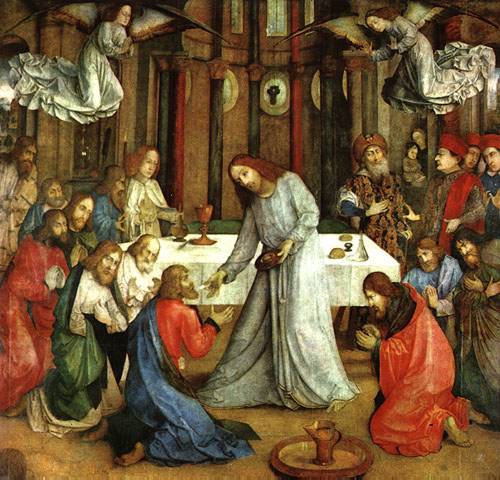
Joos van Wassenhove, The Institution of the Eucharist, c.1474
Catholic Light reports an allegation of a politician denied the Sacrament at the Arlington, Va., cathedral because he kneeled for Communion. Rev. James Tucker, a priest of the Arlington diocese, registers dismay.
The kneeling-at-Communion question has been getting an airing at HMS Blog, where Emily Stimpson writes: "[W]hile I believe we must remain obedient to our bishops, I can't help but feel frustrated by the continual efforts of some to strip away the simple acts of reverence and piety, which hurt no one and help many to grasp the mystery of the faith."
The tradition in the Catholic Church is to take Communion kneeling. That's why altar rails were also called communion rails. (Note these magnificent images from the old St. Albertus Polish Catholic Church in Detroit, here and here.)
Go to an Episcopal parish and you'll see worshipers still taking Communion that way. It has been only in the past 30 years that Catholic liturgical engineers decided standing for Communion was somehow preferable. There was no great demand from the pews for standing for the Sacrament. Indeed, kneeling has stubbornly hung-on following the Sanctus, and in many parishes, the Agnus Dei, despite the efforts of the liturgists to discourage it.
Kneeling at a rail for Communion doesn't harm the faith but enhances it. When standing is the general rule, one can see where a great show of kneeling while others are trying to proceed to the altar could be disruptive, but a quick genuflection before the Sacrament wouldn't hurt anyone.
Remember, when you genuflect or kneel before the Sacrament, you are appealing to longstanding Church tradition, much more so than the modern-day Roundheads who hide tabernacles, remove kneelers and gut sanctuaries.
Martin Luther King wrote: "I would agree with St. Augustine that an unjust law is no law at all." When clerical Cromwells actively seek to undermine age-old devotions that do no harm but instead great good, civil disobedience may be in order.
For a number of years the most popular caller on Boston sports radio was a fellow known as "Butch from the Cape." He cultivated a raffish air of mystery as to his background and whereabouts: The suggestion was he had ties to the wise guys. He was tremendously funny, calling in to the talk shows daily to deliver, in a Bronx sneer, brilliant comic riffs on the sports news of the day. He became a fixture on the airwaves, a familiar personality to millions of loyal listeners. When he died last year after a publicized battle with cancer, the news was greeted with an outpouring of grief.
But then, after his death, a story in the Hartford Courant (see below) revealed Butch from the Cape, in real life, had been a scam-artist and confidence man who had bilked scores of gamblers in sports-betting schemes. His last and most far-reaching con had been to invent himself anew for millions of radio listeners.
He had created an entire persona for himself, and become like a member of the family to sportswriters and radio listeners who sang his praises and considered him a friend – but who, in few if any cases, really knew anything about him at all.
The point is, you may think you know personalities on the airwaves – or in cyberspace – but all you really know is what's presented to you. You may think you know someone based on the persona he or she presents on the Internet. But how well do you really know a virtual friend?
Trust but verify, Ronald Reagan once said about the Soviets. It's good advice, too, in Blogistan.
THE HARTFORD COURANT
October 18, 2001 Thursday, 7 SPORTS FINAL
SECTION: MAIN; Pg. A1
LENGTH: 1463 words
HEADLINE: TRUTH IS, HE NEVER MET A LIE HE DIDN'T LIKE;
SPEERS THE CON MAN KEPT 'EM GUESSING TILL THE END
BYLINE: By EDMUND H. MAHONY; Courant Staff Writer
BODY:
Tommy Speers, ace con man, had moves so slick the police never really figured out whom he worked for. That goes some distance toward portraying Speers' skills as a swindler, because for 20 years or so, he was supposed to be working for the cops.
He was a gambler who called what he did "ripping" people. His theory of the sports bet was simple: Bet often. Collect when you win. Never pay when you lose. That, of course, was easier said than done.
But it worked for Speers until the bitter end Wednesday when he died at 58. He beat the mob, he almost always beat the police and he beat a sad line of suckers from Poughkeepsie to Cape Cod. And for the last decade, he beat thousands of sports radio fans in eastern Massachusetts.
Thomas W. Speers lost the one that counts at 4:10 a.m. Wednesday, in bed with his family beside him in his newest home on Cape Cod. It was a hard, nearly two-year fight with renal cancer.
But as always with Speers, you never got what you thought you were getting. He left his last scam intact. At the end of a life-long rip, the sports airwaves in Boston were filled with accolades for the man radio callers knew only as the mysterious "Butch from the Cape." Boston sportswriters were writing tributes to the most brilliant, perceptive, caustic, hilarious sports commentator ever.
If they knew the real Butch -- the one who terrorized bookmakers and police officers in Connecticut for decades -- they never wrote about him.
Speers lived his final decade or so at the elbow of Cape Cod in a condominium paid for by his victims. He arrived there on parole from a Connecticut gambling charge. It wasn't long before he did what he had done so successfully over a career of hooking marks: He fashioned a brand new persona. It was swallowed with equal enthusiasm by wiseguys on the Cape and the sporting crowd in Boston.
According to his new story, Speers was a New York Yankee fan and would-be writer from some unspecified upstate New York town, forced by bad breaks into life as a saloon owner. It was a slippery step from the saloon to the bookies, Speers told his new friends in Massachusetts. He told them he got caught gambling, did a short stretch in a New York jail. But there were never any details. For Boston sportswriters, Speers' last name was "none of your business." Speers was a man trying to hide a mysterious past, something he knew would only add to his allure to those in sports radio land.
"Not many people can lay claim to be being the best at anything," a writer with the Boston Herald wrote last week as Speers' life neared its end. "Butch, 58, is the best talk-show caller there is, probably the best there ever was. In many ways, he defined the art, combining a caustic sense of humor with an iconoclastic sense of mischief."
An Associated Press sportswriter reported Wednesday that when Butch from the Cape spoke into the radio, Nomar Garciaparra became "No Arm," Rick Pitino was "Coach Pinocchio," and Drew Bledsoe was either "Drew Bozo" or "Nancy Drew," depending on his mood.
When the news broke in sports radio land that Speers was suffering from a probably fatal disease, he told an interviewer: "Maybe I've got Red Sox cancer, the kind everybody beats."
Speers certainly was good on the radio; program hosts fought over him to promote their shows. He was good at a lot of things. His old handlers in the Connecticut State Police used to call him brilliant, until he started setting fire to their careers. But they remember him a little differently in Waterbury where he grew up.
In Waterbury they will tell you that the closest Speers ever came to owning a bar in upstate New York was nearly getting buried under the parking lot of a joint outside of Poughkeepsie. The bar owner was a connected wiseguy who caught Speers trying to run off on a losing bet.
For a guy who worked the wrong side of the law, Speers was uncharacteristically smart, funny, engaging and captivating. A generation of state troopers still talks about his stories about his life in crime. About a decade ago, just before he left Connecticut for good, he was handicapping football games for the guards at the Brooklyn Correctional Center. Speers was serving a short gambling sentence -- his last.
Speers has claimed that it was his first bet -- or more accurately, the fact that he won -- that put him on the wrong side of the law. He laid down $13 to win $10 on the San Francisco Giants in 1961. But it is far more likely that associates will place the beginning of Speers' notoriety at his brief dalliance with the newspaper business.
During a number of interviews in the 1980s, Speers said he was hired by the newspaper in Waterbury to collate sports scores delivered to the newsroom by wire services. He was fired when the editors discovered he was doctoring the scores to cover bets he made with local bookies.
Tossed out of the news business, Speers embarked on a career that terrorized bookmakers and sports bettors in Connecticut for more than two decades. This is how he said it worked: He would assume a false identity. A favorite was "Terry Conlon," a banker new to the state. Then he set out to ingratiate himself with a bartender or bookmaker or anyone else who looked willing to take a bet.
He bet small to begin with, paying when he lost and collecting when he won. But as his credit increased with whoever was taking the bets, Speers raised the limit. Eventually, the bet was $5,000 or $10,000, a big sum in the 1960s and '70s. If Speers won, he collected. If he lost, he disappeared. It wasn't long before a lot of people in a lot of saloons were looking for Terry Conlon, a bespectacled banker in a conservative suit.
Sports betting wasn't Speers' only game. While still living in Wolcott, he once passed himself off as a liquor store owner from the Cape. He told his mark in Naugatuck that his liquor business was such a bust that he set it on fire in a successful insurance fraud.
Speers offered the greedy mark the surviving inventory at a discount -- if the mark could provide the up-front money to cover "expenses." When the day of delivery arrived, Speers appeared without the goods. He carried with him a newspaper clipping reporting that the state police had impounded a shipment of bootleg liquor on I-84 the night before.
Using his newspaper experience, Speers had impersonated a state trooper and called a rural news bureau with a news release about an illegal liquor shipment. The fake story about the liquor bust was published.
Speers came to the attention of the Connecticut State Police in the early 1970s, about the time the agency was creating a new organized crime squad. He became the first informant, Number 01. But it wasn't long before confusion developed over whom Speers was really working for.
In a series of interviews before his death, Speers said that he would report to his handlers that he had stumbled upon a bookmaker who was taking action. Usually, he said, the state police instructed him to place bets to build a case for a bookmaking arrest. In the meantime, Speers said he kept whatever money he won. When he had enough evidence -- usually after losing a big bet -- Speers handed the bookie over.
But in many cases, Speers said, he didn't find the bookmakers himself. Rather, mobsters would direct Speers to bookmakers who weren't paying the Mafia for permission to operate.
The beginning of the end of Speers' relationship with the state police occurred in 1973. A meeting to settle a dispute between Speers and a gambler in Danbury got out of hand. When it was over, one of the gambler's two enforcers was dead. The state police covered the meeting to protect Speers and became involved in a shootout. A medical examiner's report later concluded that the enforcer shot himself in the head. There were many in law enforcement at the time who did not believe an enforcer would shoot himself to avoid arrest.
Former Chief State's Attorney Austin McGuigan began arguing that Speers should be cut loose as an informer. The state police resisted, perhaps because as many as 60 percent of their gambling arrests were based on information provided by Speers. McGuigan eventually lost his job as a result of continuing disagreements with the state police.
By the late 1980s, Speers had become too notorious to ignore and police in Waterbury arrested him on gambling charges. Speers was eventually convicted and served a brief sentence at the correctional center in Brooklyn. But before the case was over, Speers' lawyer was charged with trying to improperly influence the judge.
At the time, Speers said he was enraged by the arrest.
"I'm not content to just walk away from this," he said. "What with all the exposure and mental anguish I've had to live with."
Tuesday, September 24, 2002 What's the difference between a Mason and a modern liturgist?
Must be the handshake. Because the tastes in ritual-space design are remarkably similar.
Carrie Tomko, in a comment on the post below, notes the similarity between the modern Catholic liturgists' un-sanctuary and the Masonic altar here.
Note the altar placement in these rooms of the Philadelphia Masonic Temple – quite a remarkable building, really, in an over-the-top rococo-faux-Babylonian sort of way.
St. Albert the Great Catholic Church, which befitting its Austin, Texas, location, is fronted by a mock oil derrick. (Meantime, the mall-like baptismal pool looks well-suited to the pitching of good-luck pennies, though the purpose of the attached Tiki Hut volcano is unclear.)
Completing the Masonic parallel, though not designed by Habiger & Associates, as far as I know, two Italian chapels of the Neocatechumenal Way (which may or may not feature secret handshakes): In Catania, Sicily, and in Florence.
Monday, September 23, 2002 Replacing the missal with a Little Red Book: The forced collectivism of the liturgical commissariat
Free Republic notes the web site of a Catholic chapel in State College, Pa., that is a model of get-your-mind-right Liturgist-Speak.
The re-education in new-think proceeds apace, from the rationale for the full-immersion baptismal jacuzzi to those given for the lack of decoration or of a defined sanctuary.
Altar area: Eucharist is a celebration of the Liturgy of the Word and the Liturgy of the Eucharist. This area is the focal point of the space without being removed or isolated from the rest of the space. It is given just enough prominence to allow visibility by all present but without putting distance between this space and the rest of the room. Christians gather around the table of the Lord; they are not spectators at the Lord's table. The area is uncluttered by extraneous appointments; there is simply the Lord's table (the altar), the lectern or ambo, and the presider's chair. These are the focus of the liturgy.
Altar shape: The square design best expresses the theology that all are gathered around the table. There is no front or back, no head or foot of the table. All places are of equal importance. (A round altar can also express the concept.)
Presider's chair: While certainly not a throne, the chair's central position serves to remind us that the community does gather around someone who presides at the celebration.
Seating area: One of the challenges in designing a space in keeping with a contemporary understanding of liturgical celebrations is seating people so that they do not see themselves as spectators but as active participants in the liturgy. They are as much a part of the action of the liturgy as the presider or the reader or the choir. They are to interact with each other as well as with the presider and the reader. Their role in the liturgy is of equal importance with the roles of anyone else taking part in the action of the liturgy. We are not in a theater to watch. We are with each other and at the table of the Lord, and our seating arrangement is designed to help establish this feeling.
An important general feature of the worship space is that everything in it is portable or moveable except for the baptismal font. This allows us to gather in this room in a variety of ways, and, on occasion, to use the space for other liturgical functions as well as concerts, plays, etc. The options to rearrange the room can help to facilitate special liturgies. It might be one way to mark the change in various liturgical seasons. Furthermore, we are a pilgrim people. A pilgrim people is a people that is on the move, not fixed and permanently settled. We should not forget that.
Here we have the liturgist as modern-art critic, explaining the symbolism behind the latest innovation in worship as performance art. An argument for Mass in the vernacular was that it made the rite more accessible for the average worshiper. But if a standing class of liturgist-critics is required to intepret all the new "symbols" they are constantly inventing, from "pilgrim" folding chairs to the filling of holy-water fonts with sand, has the Mass been made truly more accessible to the average person in the pew (or "pilgrim" chair)?
Remember the scene in Dr. Zhivago when his Red commissar brother criticizes his poetry as personal and "self-indulgent"? The scriptwriter might have been borrowed for this passage on the corrupting influence of "private" devotions:
The absence of kneelers is another notable feature, related to the fact that this space is meant for public worship, not private, personal devotion. According to the rules of the liturgy of Vatican II, standing or sitting are the two preferred postures, rather than kneeling, although kneeling is not outlawed. Kneeling is a posture suited to private, personal prayer; kneeling tends to close out people around us. This should never occur in liturgy.
For similar reasons, our worship space also has no statues, no votive lights, and no stations. This space gives prominence and focus only to those elements involved in the public celebration of the church's liturgy and draws all of our attention to the sacramental life of the church. It invites us insistently to develop a liturgical spirituality. A liturgical spirituality is one which gives primary emphasis to the sacramental life of the church. Even private devotion takes its inspiration from and leads back to the celebration of the liturgy.
This is not Catholicism. This is liturgical bolshevism.
And while this is an extreme case, the trend toward forced collectivism, with the shifting of focus toward the assembly, and an emphasis on Mass as shared meal rather than sacrifice, is why many blanche at the seemingly innocuous imposed handshake with "Christ in your neighbor" that Fr. Johansen mentions.
The Project Canterbury site is a gem, and well worth a cross-Tiber visit.
A tip of the biretta to Fr. Jim Tucker for calling attention to the site and, in particular, to this vintage travelogue posted therein, Ceremonial Curiosities and Queer Sights in Foreign Churches: Ecclesiological and other notes from the travel diaries of Edward J. G. Forse, M.A., F.R.G.S. The frontispiece portrait is priceless.
#
When the B in BVM stands for Bisuteki
A Free Republic thread on the proposed new church at Fatima draws a comparison to the George Foreman grill. I'm thinking there are Hibachi elements, with a touch of early Stephen Foster banjo.
Globe scribe, defending NPR ramparts, attacks Harvard president on anti-Semitism warning. But the 'intellectual fraud' in this case isn't Larry Summers.
Boston Globe columnist Eileen McNamara paints Harvard President Larry Summers as an "intellectual fraud" for warning of anti-Semitism in the campus Israel-divestiture movement.
Ascribing bigotry to those with whom you disagree is the last refuge of cowards. It is especially offensive from a university president, McNamara writes.
During his address at morning prayers in Memorial Church last week, Summers tried to have it both ways. Insisting that he values vigorous debate and academic freedom, he nonetheless upbraided certain Harvard students and professors for ''advocating actions that are anti-Semitic in their effect, if not their intent.''
Summers cited a petition urging the university to divest in Israel because of its policies toward the Palestinians, a call that the president said serves unfairly ''to single out Israel among all nations as the lone country where it is inappropriate for any part of the university's endowment to be invested.''
The merits of divestment as a means of exerting political pressure on the government of Ariel Sharon is a worthy topic of debate, even of heated argument, but for Summers to suggest that proponents of that strategy are racists is to marginalize, in the ugliest possible way, the views of people no less principled than he.
"No less principled than he?" "Marginalize?" The guiding light of the MIT-Harvard divest-from-Israel campaign is Noam Chomsky. Gallons of ink have been spent debunking the so-called Peter Pan of the anti-American Left. (Here are two fine savagings, courtesy of Alan Dershowitz and City Journal's Stefan Kanfer.) But a passing familiarity with the Chomskyite faction behind the divestiture campaign – in Dershowitz' description "a motley assortment of knee-jerk anti-Zionists, rabid Anti-Americans, radical leftists (the Spartacist League), [and] people with little knowledge of the history of the Arab-Israeli dispute – would be enough for most sentient beings to dismiss the effort.
And singling out one bad actor on the international stage for retribution is hardly unique to these petitioners. Witness the Bush administration's focus on Iraq, to the exclusion of Iran and other unstable nations that also harbor terrorists.
Yeah. Even if these Ivy League protesters are wrong, what about that simpleton Bush? How much more enlightened US foreign policy would be, were it only guided by the Globe editorial department, or by the Unitarian peace activists from Somerville who must surely serve as a barometer of public opinion, given their overwhelming prevalence in the newspaper's Letters to the Editor section.
That his business and political experience did not entirely prepare Summers for the freewheeling atmosphere of university life has been clear since his arrival at Harvard.
That would be a reference to the Cornel West brouhaha. It might come as a revelation to Eileen McNamara that rapmaster West's departure for Princeton has not universally been viewed as a loss to the Crimson.
It was evident again when he cited as an example of encroaching anti-Semitism a rally against global capitalism in which chanting students could be heard equating Sharon and Adolf Hitler. Well, a German justice minister last week reportedly compared President Bush's tactics toward Iraq to Hitler's toward Europe before World War II. Is she anti-American or merely hyperbolic?
Both?
To lump, as Summers did, the intemperate chants of students with such genuine signs of the rise in worldwide anti-Semitism as the burning of synagogues and the popularity of neo-Nazi political candidates across Europe, is to mistake unpopular speech for race hatred.
To not lump them together is to miss that rises in overt anti-Semitism and synagogue-burnings have accompanied the tide of anti-Israeli and anti-American rhetoric on the Left during the Mideast crisis.
Has Eileen McNamara simply not been paying attention? Has she missed reports out of San Francisco or Berkeley or Canada on anti-Semitism amid the campus Left? Has she not heard of Cynthia McKinney, or read the MEMRI transcripts of what passes for Arab news coverage?
Did she simply crank out a high-dudgeon column without bothering to examine the issues or her own comfortably-held prejudices? Or can it be that accepting Larry Summers' warning would mean acknowledging an uncomfortable truth: that the socially-conscious NPR-listeners who constitute Eileen McNamara's readership have been siding with the Brownshirts, have been siding with the Klan?
Who, in this case, is really the intellectual fraud?
Did an angel really appear in the sky over a Belgian battlefield in August 1914 to safeguard British troops? The tale was one of the earliest and most enduring pieces of folklore from the trenches of the Great War.
Alistair Cooke recalled the story on a visit to Ground Zero following 9.11.
When, last week, I first saw what so many firemen, doctors and nurses were moving about in - the huge, raw landscape of fog and rubble and twisted steel and what we now call, without a wince, body parts - my memory immediately matched the scene with the newsreel pictures we saw 80-odd years ago every week in what to me was known as the local picturedrome - a rotted landscape, no foliage, no leaves, trees shot down to broken matchsticks in a miles-wide tangle of barbed wire decorated with body parts.
In the midst of one thundering battle there appeared in the night sky a glowing figure in a frame of blinding light.
All the thousands of soldiers saw was the figure of an angel - it became known as the Angel of Mons - and in time the sensible wisdom was that it had been seen by either the very religious or the very naïve.
But hundreds of soldiers who were neither swore they had seen in it an angel of deliverance.
A legend? Likely. Yet one recalls the exchange in Brideshead Revisited in which the skeptic Charles queries Sebastian on his faith:
"But my dear Sebastian, you can't seriously believe it all."
"Can't I?"
"I mean about Christmas and the star and the three kings and the ox and the ass."
"Oh yes, I believe that. It's a lovely idea."
"But you can't believe things because they're a lovely idea."
"But I do. That's how I believe."
The campus as ideological monopoly:In the administrations and on the faculties of nation’s universities, Republicans and conservatives are almost as rare as unicorns, writes David Horowitz, who has launched a campaign against bias in the academy.
Here's how John Leo describes campus life: Debate has virtually disappeared, and there isn't much diversity of opinion…Graduate students who want to become academics know they can't rise within the system unless they display liberal views. Professors know they are unlikely to get hired or promoted unless they embrace the expected package of campus isms–radical feminism, multiculturalism, postmodernism, identity politics, gender politics, and deconstruction. Remaining conservatives and moderates can survive if they keep their heads down and their mouths shut. Dissent from campus orthodoxy is risky. A single expressed doubt about affirmative action or a kind word about school vouchers may be enough to derail a career.
Fighting the good fight for academic freedom of thought is a group called FIRE, the Foundation for Individual Rights in Education. Stanley Kurtz of NRO pens a tribute: When it comes to America's politically correct campuses, all is not lost. In fact, in some important respects we are actually beginning to win the battle for freedom of thought at America's colleges and universities. That is largely because of a feisty little three-year-old named FIRE, the Foundation for Individual Rights in Education. Everyone who cares about intellectual freedom in the American academy needs to know that there is real reason for hope.
Fr. Fessio recalled from exile: To serve as chancellor of Ave Maria University. More on the controversy surrounding his involvement with Campion College of SF and DC.
Monday, September 16, 2002 Another architectural assault on Our Lady?
Planned Sanctuary of Fatima
It is unclear whether Our Lady of Fatima ever revealed a secret such as this: You shall build in my name a church that resembles a great flapjack griddle.
Yet here (last item) is the first-prize winner in an international architectural competition to design a new church* at Fatima in Portugal.
(And here, apparently, is an entry that didn't win.)
This V isn't for victory: Maureen Mullarkey on the latest at the Brooklyn Museum, which seeks to ensure you never look at Hatshepsut the same way again. (But Susan B. Anthony?)
#
Friday, September 13, 2002 Threatened treasures of German-American church art
Cosmas Wolf, Design for a High Altar at St. Peter's Church, St. Peter, Indiana, 1864
A monograph by art historian Annemarie Springer traces the history of 19th-century German-American artists who decorated mission churches erected by their immigrant countrymen in North America. The accompanying illustrations are remarkable. Some examples:
Springer writes in her introduction: Time is running out for a great number of nineteenth century churches that have fallen victim to neglect, removal, or alterations. Due to ethnic population shifts and to urban sprawl, former German neighborhoods have undergone drastic changes. In addition, the Second Vatican Council, which met between the years 1962 and 1965, reintroduced a freestanding altar in Catholic Church sanctuaries. The priest celebrating Mass now faces the congregation and no longer the wall behind the altar. Such change prompted many members of the clergy, intent on modernizing the Catholic Church, to alter all of the interior furnishings. Altars, altarpieces, pulpits, statuary, pews, and other "old fashioned" art objects were removed or stored and can no longer be located. Such has been the fate of a large number of works by German-American church artists. There is great danger of more loss.
On the bright side, many local historic preservationists have become aware of the problem during the past twenty years. Dedicated parish members have in many instances collected funds from private and corporate donors for restoration of their churches' interior and exterior. Librarians and archivists have started to research parish records for the purpose of documenting the ethnic and artistic history of immigrant churches that are again regarded as important American edifices. It is also heartening to discover that the Archdiocese of Chicago maintains a repository for art objects and church furnishings that were removed whenever a parish church has been closed during the past ten years. Such objects are then distributed among less prosperous parishes where they can be displayed and enjoyed by the congregation. The effort of the Chicago Archdiocese is just one example of recent awareness by Church officials that steps need to be taken to halt the loss of precious materials.
It is to be hoped that this discussion of one aspect of German-American contribution to the cultural life in the U.S. will stimulate interest among students of history and art. They will be richly rewarded.
A parent's view of 9.11: From Lileks and from Amy Welborn. If you have young children, these posts summon anew that sick feeling in the pit of the stomach.
From Shanksville, Pa., the new Gettysburg, comes this dispatch from E. L. Core on the inspiring valedictory given by Pennsylvania Gov. Mark Schweiker at the 9.11 memorial ceremonies:
Today, we stand on a battlefield.
It is unlike other battlefields in our nation's history because that day America's first defenders weren't battle tested.
They weren't even armed.
They were ordinary Americans who were off to work or to visit family.
And in an instant, they became one of the most heralded military units in our nation's rich history.
Some say that America's war against terror really began when our armed forces landed in Afghanistan last October.
But we know better. Those of us here today know better.
It was here that freedom took its first stand....
Readers stirred by Shea-vian invocations of the noble Thidwick may wish to visit this site devoted to the wartime art of Dr. Seuss, who in his pre-Sneetch period enthusiastically rattled pen and saber against the Axis of Evil. Note the parallels to the present day in these cartoons:
Euphoniously-named Evansville Bishop Gerald A. Gettelfinger may have been named one of America's Worst Bishops, but the Episcopal Church USA probably would love to have him after this embarrassing ramble that argues America brought 9.11 upon itself.
Let us never forget that those who terrorized us were committed to the mission of “getting our attention.” They died for their cause—just to get our attention!
Must we Americans continue to be blind? Must we continue to be deaf? Have we forgotten the haunting ballads of the late 1960’s? How many more must die?
The answer is blowin' in the wind – the one whooshing unhindered through His Eminence's mitered noggin.
I have met them at close of day Coming with vivid faces From counter or desk among grey Eighteenth-century houses. I have passed with a nod of the head Or polite meaningless words, Or have lingered awhile and said Polite meaningless words, And thought before I had done Of a mocking tale or a gibe To please a companion Around the fire at the club, Being certain that they and I But lived where motley is worn: All changed, changed utterly: A terrible beauty is born.
II
That woman's days were spent In ignorant good will, Her nights in argument Until her voice grew shrill. What voice more sweet than hers When young and beautiful, She rode to harriers? This man had kept a school And rode our winged horse. This other his helper and friend Was coming into his force; He might have won fame in the end, So sensitive his nature seemed, So daring and sweet his thought. This other man I had dreamed A drunken, vain-glorious lout. He had done most bitter wrong To some who are near my heart, Yet I number him in the song; He, too, has resigned his part In the casual comedy; He, too, has been changed in his turn, Transformed utterly: A terrible beauty is born.
III
Hearts with one purpose alone Through summer and winter, seem Enchanted to a stone To trouble the living stream. The horse that comes from the road, The rider, the birds that range From cloud to tumbling cloud, Minute by minute change. A shadow of cloud on the stream Changes minute by minute; A horse-hoof slides on the brim; And a horse plashes within it Where long-legged moor-hens dive And hens to moor-cocks call. Minute by minute they live: The stone's in the midst of all.
IV
Too long a sacrifice Can make a stone of the heart. O when may it suffice? That is heaven's part, our part To murmur name upon name, As a mother names her child When sleep at last has come On limbs that had run wild. What is it but nightfall? No, no, not night but death. Was it needless death after all? For England may keep faith For all that is done and said. We know their dream; enough To know they dreamed and are dead. And what if excess of love Bewildered them till they died? I write it out in a verse -- MacDonagh and MacBride And Connolly and Pearse Now and in time to be, Wherever green is worn, Are changed, changed utterly: A terrible beauty is born.
Tuesday, September 10, 2002 'A date that ought to be among the most famous in history'
Today we are accustomed to think of the Mohammedan world as something backward and stagnant, in all material affairs at least. We cannot imagine a great Mohammedan fleet made up of modern ironclads and submarines, or a great modern Mohammedan army fully equipped with modern artillery, flying power and the rest. But not so very long ago, (less than a hundred years before the Declaration of Independence), the Mohammedan Government centred at Constantinople had better artillery and better army equipment of every kind than had we Christians in the West. The last effort they made to destroy Christendom was contemporary with the end of the reign of Charles II in England and of his brother James and of the usurper William III. It failed during the last years of the seventeenth century, only just over two hundred years ago. Vienna, as we saw, was almost taken and only saved by the Christian army under the command of the King of Poland on a date that ought to be among the most famous in history-_September 11, 1683. Hilaire Belloc, The Great Heresies, Chapter Four.
Matthew Alexander, who returns with this homage to assassinated Empress Elisabeth of Austria, promises an extended post on the Siege of Vienna, so keep an eye on his site.
#
On Hallowed Ground: Dave Barry, in a moving elegy, remembers heroism in Pennsylvania.
Monday, September 09, 2002 Saved, but Degraded: The Rescue of St. Vibiana's Cathedral: Very interesting thread at Free Republic on the Los Angeles' beautiful old cathedral, which reportedly could have been restored for $18- to $20 million. Included is an old St. Catherine Reviewarticle by Michael Rose on the rush by the archi-liturgical establishment to make modernist revisions before foreseen changes could be made in Church architectural guidelines.
It's a good time for war: Proving Osama bin Laden wrong is the right thing to do. And when we remember that victory is certain, we can stop scaring ourselves to death.Christopher Hitchens writes in the Boston Globe Magazine.
Re-entering the Cathedral, he went up into the choir. The nave was mirrored in the surface of the brimming holy-water stoups, with the beginnings of the arches and some portions of the windows. But the reflection of the stained glass, though broken at the marble's rim, was continued farther on, upon the flagstones, like a many-coloured carpet. The brilliant daylight from without was projected throughout the whole length of the Cathedral in three enormous rays, through the three open doors. From time to time a sacristan would glide across the transepts, making the sideways genuflexion of a devotee in a hurry. The crystal lustres hung motionless from the ceiling. Within the choir a silver lamp was burning, and from the side chapels and the darker portions of the church there stole from time to time a sound like the exhalation of a sigh, accompanied by the noise of a grille shut to, that echoed on and on beneath the vaulted roof. Gustav Flaubert, Madame Bovary, Chapter 25.
Holy-water fonts or stoups have been found since time immemorial at the doors of churches. "All medieval churches had holy water stoups, but they were either destroyed or filled in at the Reformation," notes this site devoted to churches in Suffolk, England. (Horses could have been accommodated at All Saints, Hollesley.)
The web site of the Immaculate Conception Cathedral in Kansas City offers a primer on holy-water fonts as extensions of the baptismal font.
A contributor to a Catholic Information Network thread comments on an unfortunate trend that has accompanied the rise in popularity among modern liturgical engineers of the living-water baptismal tub: What I _don't_ like is removing all the _other_ holy water fonts from other entrances. In the Nashville cathedral, for example, they removed them all--but the parking lot is _behind_ the church, and almost no one enters by the front doors, which face the busiest street in the city. As a result, one has to travel the length of the church to bless oneself, or forgo it.
Christian scholars' statement 'heralds new era in Jewish-Christian relations.' A group of Catholic and Protestant scholars have released a document that asserts an enduring saving covenant between the Jewish people and God, rejects the targeting of Jews for conversion to Christianity, and affirms the importance of the land of Israel to the Jewish people. More from the Boston Globe and Boston Herald.
Maureen Mullarkey sends along this passage by Jewish theologian Michael Wychograd: This man, this Jew, this servant, this despised, crucified Jew, was not just human but in him could be detected the presence of God. The church held fast to this belief because it held fast to this Jew, to his flesh and not only to his spirit, to his Jewish flesh on the cross, to a flesh in which God was present, incarnated, penetrating the world of humanity, becoming human. The church found God in this Jewish flesh. Perhaps this was possible because God is in all Jewish flesh, because it is the flesh of the covenant, the flesh of a people to whom God has attached himself, by whose name he is known in the world as the God of Israel. Perhaps for some mysterious reason, the church, the gathering of Gentiles drawn to the God of Israel, could not see this incarnation in the Jewish people but could see it in this one Jew who stood, without the church realizing it, for his people. Perhaps the crucifixion of Jesus can only be understood in the context of the crucifixion of the people of Israel, whose physical presence challenges those who hate God because in this people they see the God they hate. Perhaps the bond between Jesus and his people is much closer than has been thought.
Hugo Gurdon of the National Post writes: Jingoism came of age in 1878 when Disraeli sent a British fleet to the Eastern Mediterranean to counter Russian expansion in Turkish waters. It was good policy to contain the Russian empire in its Tsarist phase, just as it was in its Soviet phase. But, as with the war against Islamism and the coming battle with Iraq, some enthusiasts for the policy were of a type calculated to prompt stamping and whinnying in the liberal stable.
The music hall Jingo song that became popular at the time was enlivened by splendidly gore-chilling stuff about the Russian bear, "all bent on blood and robbery [having] crawled out of his lair," and the martial anthem crowed about the "thrashing" that the lion administered to the bear every now and again when old bruin got uppity. But the core and most quoted view of the jingoist was:
'We don't want to fight but by jingo if we do
We've got the ships,we've got the men
And got the money too.'
Not a word of this is objectionable. It is, rather, a cardinal statement of the right way to approach war -- not as desirable in itself but as something that, if unavoidable, should be undertaken with the vigour, determination, weaponry, soldiery and financial commitment necessary to secure victory…
The lesson isn't the one suggested by peacenik lapel buttons that "War is not the answer." The answer depends on the nature of the question. And if you're enquiring about the best way to eliminate the threat posed by a dictator such as Saddam Hussein, who is building weapons of mass destruction and who is probably behind terrorism on U.S. soil, then war may well be the answer. War resulting in decisive victory and defeat has, historically, been highly effective in settling issues between otherwise irreconcilable enemies... #
Calatrava's design is more attractive than the LA Cathedral. It's not a concrete box. OTOH, where are they going to put the Stations? The steel-and-glass structure seems to rule out the option of representing them with paintings.
The design aims to represent a pair of praying hands, from the outside, but on the inside, avoids iconography and relies on the abstraction of "light" as a theme. The effect is rather impersonal. One practical detail: if a server ever has to go and fetch something during a Mass, it's going to be a long walk.
Overall, I'd have to say that even though the building is striking, it is somewhat simple: there aren't various places to explore, many points of interest, or many possibilities for future development. What you see is what you get.
Oh, one more worry: don't odd-shaped windows leak? This guy could design some very nice air terminals.
From John Hench:
Christ the Light Church is interesting, but to be honest, it appears that the Church is basically one giant rib-cage. It might have been called St. Jonah's - although I suppose Jonah never did see the rib-cage from the whale's stomach.
Nevertheless, this Cathedral illustrates a number of problems with modernist architecture:
1) Modernist architecture is high-concept, but not necessarily beautiful. Sure, an architecture critic can wax glowingly to head nodding colleagues, but no one's breath is taken away by its sheer beauty.
2) Modernist architecture shuns ornamentation. Visual effects are left at the large scale, without any ornamentation on a human scale or smaller.
3) Modernist architecture uses materials that are mass producible. No stonework wrought over centuries - only concrete poured into forms on a two week schedule. What's more, the materials tend to be cheap - no expensive stone, wood, gold, or pigments.
4) Modernist architecture relies too heavily on right-angles or analytic curves (e.g. hyperbolic parabaloids).
5) Modernist architecture avoids color - white, tan, and gray seem to be favorites.
6) Modernist architecture seems to be stuck in a rut. Just as the post Vatican II mass seems to be mired in 1970s folk music dominated by poorly tuned 12 string guitars and tambourines, modernist architecture can't break out of the concrete dominated brutalist mold from roughly the same period.
7) Modernist Architecture invariably prefers the abstract over the representational, and where the representational cannot be avoided (e.g. Christ crucified) it is heavily stylized as a means of compensating for its representational aspect.
Now, does this mean that the only valid architecture is Gothic? Heavens no. One of the most beautiful churches I've seen is the chapel at St. Patrick's Seminary in Menlo Park. An Art Nouveau masterpiece. Even the church of the IHM in Prague, while unorthodox (Bauhaus), has stunning interiors.
What I'd love to see is a new synthesis of some of the art movements of the late 1800s - early 1900s (Art Nouveau, Impressionism) incorporating more modern forms (e.g., fractals or a wider range of newly discovered forms from the natural world) yet keeping the former emphasis on color and human scale ornamentation.
Most importantly, beauty must be a virtue strived for, with all of its attendant theological implications (truth, holiness, etc.).
One of the things which weighs on my spirit is the preponderance of ugly public edifices. Strip malls, LA style 4 lane thoroughfares, concrete office blocks, cookie cutter tract houses, etc. I think the church has a real opportunity to preach a different view of life through its sacred architecture, but has missed it. I think it is not unreasonable for lay people to support the movement for more beauty in church architecture.
In Los Angeles, a cathedral of breathtaking beauty
St. Sophia Greek Orthodox Cathedral, L. A. Take a photo tour.
In 987, Prince Vladimir of Kiev is said to have sent emissaries to different countries to learn about the religion and worship of each. He was searching for an appropriate faith for his people.
In Constantinople, they were taken to Hagia Sophia, the cathedral church of the capital. Their report: "We knew not whether we were in heaven or on earth. For on earth there is no such splendor or such beauty, and we are at a loss how to describe it. We know only that God dwells there among men, and their service is fairer than the ceremonies of other nations. For we cannot forget that beauty."
Prince Vladimir was convinced, and his subjects accepted Greek Christianity and were baptized.*
Reader Michael Z. writes he isn't sure whether to laugh or get a headache over this TCR apologia for the Taj Mahony.
Still, even Oceania had to have a re-write department in the Ministry of Truth, for this little piece of anti-INGSOC thinking gets into the article: The writer is disappointed that there are no Holy Water fonts for people to bless themselves with as they enter…But no bad thoughts allowed :
"But I've decided to give the Cardinal a pass on this one, for now, because it's obvious that they are still doing a lot of work, so maybe those will be installed later."
I've been directing people to your blog for the LA Times quote that Mahony was taking credit for every single detail of the Cathedral, even the light bulbs on the freight elevator ! But OOPS ! The whole idea of HOLY WATER slipped his mind. I guess the freight elevator chewed up so much of his time, that he hasn't gotten around to the Holy Water yet ...
The whole Holy Water font issue shouldn't trouble us, because, TCR assures us, ROME WILL TAKE CARE OF IT IN GOOD TIME (i.e., as Fr. McCloskey says, "check back in a thousand years" )…
There you have it -- The Voice of Orthodox Catholicism at the Dawn of the 21st Century: "So what if there are no Holy Water fonts?"
Instead of taking any action, we are supposed to wait around for Vatican III...
An interesting – and quite telling – detail to leave out of a micro-managed $195-million cathedral. So now worshipers entering the church have taken to blessing themselves from the Jacuzzi baptismal font.
A question: To what does one genuflect upon entering the pew when the Blessed Sacrament is over in a corner somewhere?
Each other, one supposes, in the new Church of Me.
The U.S. Navy has ordered all ships to display the first Navy Jack during the War on Terrorism. This page is happy to follow suit. Read more on the historic American rattlesnake flags here and here.
#
To Coventry the Peace Rock rolls, with a message of moral equivalence
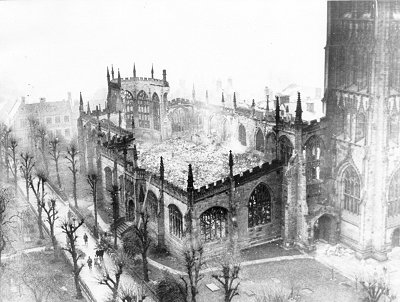
Coventry Cathedral, November, 1940. Responding militarily in self-defense is as bad as terror bombing, Peace Abbots maintain.
The pet rock of the Peace Abbey in Sherborn, Mass., is the Memorial Stone, a one-ton slab of granite hauled from place to place in commemoration of civilian casualties of war. The megalith is now said to have been welcomed for long-term placement at rebuilt Coventry Cathedral, famously bombed in the Nazi Blitz.
The sentiment accompanying the boulder is expressed on the Peace Rock page in a harangue by one Charles Mercieca, Ph.D, president of the International Association of Educators for World Peace, NGO, United Nations (ECOSOC), UNDPI, UNICEF, UNCED & UNESCO, an archive of whose florid writings decrying the Nazism of contemporary America and singing the praises of Fidel Castro's Cuba may be read here.
What is the difference between the massacre of 5,000 innocent civilians killed by a lawless group of virtually unknown origin and the massacre of 5,000 innocent civilians massacred by a legally existing agency known as the military? As far as the lives of these innocent people are concerned, it does not make any difference at all. However, as far as our government officials are concerned, there is a great difference. In fact, US government officials have referred to the innocent civilians killed in New York and Washington, DC as "victims" while they view the innocent civilians killed in Afghanistan with American weapons merely as "collateral damage!"
In other words, when the killing of the innocent comes from an unauthorized group, then we attribute that to an act of terrorism. On the other hand, when the killing of the innocent comes from an authorized group, such as the military, then we call that an act of duty and patriotism!"
WAR IS THE REAL ENEMY.
The Peace Abbots appear to make no distinction between the aggressions of attacking Nazis and fighting in self-defense against those assailants – war is war, they declare, and they take no sides.
But their sort do take a side, as George Orwell wrote in 1942, two years after Coventry Cathedral was being destroyed by the Luftwaffe.
"Pacifism is objectively pro-Fascist. This is elementary common sense. If you hamper the war effort of one side you automatically help out that of the other. Nor is there any real way of remaining outside such a war as the present one. In practice, 'he that is not with me is against me.'" *
Michael Kelly writes: An essentially identical logic obtains now. Organized terrorist groups have attacked America. These groups wish the Americans to not fight. The American pacifists wish the Americans to not fight. If the Americans do not fight, the terrorists will attack America again. And now we know such attacks can kill many thousands of Americans. The American pacifists, therefore, are on the side of future mass murders of Americans. They are objectively pro-terrorist.
This morning, on the sidewalk outside the Peace Abbey, a statue of Mother Teresa stood adorned with a black armband. At her feet burned an eternal flame, from a smoking kerosene cannonball of the type used in highway projects. She is among the ecumenical smorgasbord of historic peacemakers appropriated by the abbots for their paper-crane pantheon. Her plaque went up today. Late Beatle George Harrison is to be honored this fall. Praise the Lord, and pass the origami.
I've decided to write to the abbots to propose some additional honorees for their peace memorial. Here's my letter:
Dear Sir or Madam:
I would like to propose three new inductees for your palladium, each of whom embodies, in his own way, the spirit of your abbey's peacemaking efforts:
As a symbol of the United Nations' contributions to world harmony, the new head of the UN Human Rights Commission, Muammar Khadafy of Libya.
As a symbol of commitment to the international peace process, Neville Chamberlain of Great Britain.
And as a symbol of person-to-person friendship and collaboration with those whom some would insist upon calling enemies, Vidkun Quisling of Norway.
Wednesday, September 04, 2002 Which church would captivate our children's imagination more?
Which church would "speak" more to the broken-hearted, the sorrowful, the lost? Which church seems to sing the glories of creation and of art and of "holiness" and of "catholic fulness"? Gerard Serafin, on the proto-cathedral of Bardstown, Ky.
Consider:
The old LA cathedral
The new LA cathedral
To echo Gerard on Kentucky:
I know which church would have the feel of "home" for me! I know which church would transport me into the Presence and the communion of the saints!
El Cantico del Alba, a devotional song about the Virgin Mary, was sung by the Spanish missionaries of California each morning on awakening. Listen to an excerpt. And visit the California Missions site for more music and history.
Proposed Oakland Cathedral: modern – but eye-catching
Hey, if you're going to have modern church architecture, you can at least try to make it interesting, as they have in Oakland. Read more about that diocese's planned Christ the Light Cathedral here and here, and about architect Santiago Calatrava here and here.
George Neumayr writes in The American Prowler: Were Mahony's predecessors alive to see the grand opening of the cathedral, they would have wondered what new Protestant sect had arrived in La-La land.
The cathedral looks like a superdome for syncretism. Partially seen from Highway 101, the cathedral presents no obvious evidence of Catholicism. Drivers will assume it is a modern art museum, or perhaps an assembly hall for amorphous religious gatherings.
San Francisco has an equally confusing cathedral. It looks like a modern appliance. But at least people find it accessible. Not so with Mahony's new cathedral. "It is hard to get to," says Architect Frank Gehry.
But Mahony hopes to correct this little problem by asking taxpayers to build a new highway ramp. That should cost around $25 million…
Mahony's real reason for establishing a new cathedral is that he is practicing a new religion. Whatever it is, it is not Catholicism. Eli Broad, a non-Catholic developer and Democratic Party godfather who helped finance the cathedral , calls it "architecture for the ages." Many Catholics, when they look up at the tapestries on the walls depicting people in sneakers and birkenstocks, will wonder if it can last even a generation as a Catholic building…
Sunday, September 01, 2002 Our Lady, Queen of the Angels
Mexican folk retablo
This excerpt from a Los Angeles Timesarticle this weekend on the Taj Mahony is telling:
The cardinal has had final say on every decision regarding the cathedral, down to the wattage of the lightbulbs in the freight elevator. His taste and influence are as much a foundation of this building as the earthquake-savvy base isolators that hold it up.
He had conversations with [sculptor Robert] Graham about the doors, he says, but the artist chose the images and symbols. The only thing Mahony insisted on was an actual statue of Our Lady, which Graham originally had not been interested in doing.
"I told him the cathedral was named after Our Lady of the Angels," Mahony said, "and our city was named after Our Lady of the Angels, so at some point along the way people would expect to see Our Lady of the Angels."
You would think. Yes.
And the result? The Bird Girl in a Hospital Johnny. Our Lady of the Manicurists.
What a missed opportunity, this cathedral built to last five centuries.
Why couldn't the designers of a cathedral for a city named by 18th-century Spanish missionaries El Pueblo de la Reina de Los Angeles, Town of the Queen of the Angels, have looked to Catholic Mexico for artistic inspiration?
Imagine, instead of spare and sterile modernism, the colorful mosaic of angels and saints found in Mexican churches?
Go here and scroll down for a beautiful gallery of Mexican folk retablos. Imagine art like this or this in a cathedral.
Alternately, designers could have looked across town to the Getty Museum, which recently hosted "Queen of Angels," an exhibition of Marian devotional art of the Middle Ages, like this, and which has other magnificent holdings of religious art, like this Renaissance Flemish painting of the Assumption, or this study for an 18th-century Italian fresco of the miracle of the House of Loreto.
Indeed, the section of the Getty Museum's online catalogue devoted to Mary contains 143 images, all of them striking.
Examples of beauty in religious art, from folk to classical, are readily available in southern California. The source of inspiration for the cathedral designers, however, is anyone's guess.
Tom Brennan at Agenda Bender offers one perspective:
Not only does the Catholic Church have a gay sex scandals problem, it's got a gay sublimated Cecil B Demille set designer problem. And the second problem might end up being the more costly.
Welcome, Israpundit: A group of bloggers has launched a new web site devoted to Pro-Israel advocacy, with the aim of countering what organizers see as a Palestinian propaganda tilt to mainstream media coverage of the Mideast conflict. "IsraPundit may not succeed in reversing the damage that has already been done, but is sure will try," declares the mission statement. Ad Orientem is proud to be listed among the page's featured links.
#


![[SMMMHDH]](http://www.mgilleland.com/music/smmmhdh.png)