"He instinctively can find the shining greatness of our American culture and does a good job of highlighting it (although he also does have those rare lapses when he writes about hockey, but that is something caused by impurities in the Eastern waters or something)." Erik Keilholtz
Under the patronage of St. Tammany
Mark C. N. Sullivan is an editor at a Massachusetts university. He is married and the father of three children. Email
In Iraq, prostitutes have been beheaded by sword, their heads left on their doorsteps as grim warning. Slander of Sadaam is punished by cutting out the offending tongue. Defacing a poster of Sadaam brings a bullet. Chemical weapons have been used for practice on the Kurds.
How do members of the group Voices in the Wilderness propose to help these Iraqi civilians? By supporting US efforts to oust Sadaam?
No – by seeking to undermine US action against the despotic regime, through the sending of "peace teams" to Iraq to sing Kumbaya when the daisy-cutters begin to fall.
This is the same chorus that doggedly lamented the horrors visited by US bombers on Afghan civilians – even as the citizens of free Kabul threw off burqas, played music and sang the praises of the Americans who had liberated them. The same logic might have been used to protest the Allied Invasion of Europe, due to the potentially deleterious effects on the Belgian peasantry.
Voices in the Wilderness is looking for individuals who are interested in going to Iraq in the event of a major US assault…[A]pplicants should plan on an indefinite stay as there is no guarantee that roads leading in or out of the country will be easily navigated in the event of an assault or invasion.
We realize that we are asking a lot of people. Team members will be asked to clear their schedules indefinitely, potentially risk their lives in a war zone, pay their own way, and beforehand, inform us about your support network and send references!
Please understand that our most important task, presently, is to prevent a military attack against Iraq. The Iraq Peace Team is much more than a nonviolent presence inside Iraq. There is much work to be done here at home, before and if necessary, during a war. We are encouraging people to form affinity groups in their communities to work creatively and nonviolently against the pending war and to be prepared to act in solidarity with the group in Iraq if a war break out. This would mean distributing reports from the group to representatives and the media, holding vigils, fasts, and rallies. These are just a few of the possibilities. A “Pledge of Resistance” against a US assault against Iraq is being developed, and once it is finished, it will be posted on this site.
"Fifth Column," in this case, is not a term of exaggeration. (Neither is "lunatics." The urge to seek out an active war zone as a site for Berkeley-style leftist candlelight vigils calls to mind an acid comment of the late George Wallace: "Any anarchist scum who lies down in front of our car when we get to be president, it'll be the last car he'll ever lie down in front of." Same goes for an AC-130 gunship, only more so.)
Meantime, in Berkeley, the group Queers Undermining Israeli Tyranny, or QUIT!, protested the treatment of Palestinians by laying siege to Starbucks.
Their street theatrics would win points for creativity if parody were all:
Workers in the café were surprisingly unruffled as the Queer Defense Forces entered the café and announced over a loudspeaker that the land had been confiscated by the Queer National Fund and curfew for straights would begin in five minutes. Several “patrons” were forcibly ejected from the café by means of SuperSoakers (which were especially popular with a three-year-old settler). Many coffee drinkers quickly cleared out, but one group of chess players steadfastly ignored the group, who vow to set up more settlements in the coming months.
But when you consider the cause being advanced – a cause that lynches women, warps children and celebrates mass murder – the satire doesn't seem quite so funny.
And when you go on to consider the brutality with which Islamists actually treat gays, while Israel is the only country in the Middle East to uphold homosexuals' rights, the whole thing defies credulity.
By what bizarre moral calculus do bohemian eccentrics of the Left protest societies that protect and tolerate their dissent, in the name of strong-arm political movements that would silence them instantly by sword or Kalashnikov?
Wednesday, August 28, 2002 Brewer. Patriot. Anti-Papist.
"Much more is to be dreaded from the growth of Popery in America than from the Stamp Act." *
"Our forefathers threw off the yoke of Popery in religion; for you is reserved the honor of leveling the popery of politics. They opened the Bible to all, and maintained the capacity of every man to judge for himself in religion. Are we sufficient for the comprehension of the sublimest spiritual truths, and unequal to material and temporal ones?" *
Samuel Adams
Well, Sam Adams never was a friend to Catholics. And the brew named for him is more a "Cheers"-style marketing phenomenon than a real Boston beer. (It was brewed first in Pittsburgh and now in Cincinnati.)
So those boycotting the so-called Boston Beer Co. won't be missing much. Indeed, there are some fine – and in my view, much better – brews actually made in New England for those thirsting for hops and barley with their bean and cod.
Here are some that are highly recommended. Click on the pics for more info.
The holiday fests that Harpoon hosts for St. Patrick's Day and Christmas at its Boston waterfront brewery are, to put it mildly, convivial. Nice IPA. And do try the Winter Warmer.
A summer night at Hadlock Field in Portland. The Sea Dogs on the field. And Geary's on tap. Bliss.
Smuttynose! Come for the name, stay for the Shoals Pale Ale and Old Brown Dog.
Visit his weblog for his thoughtful posts on L'Affaire Dreher and other topics. And do make a detour to his poems, inspired by the seasons. A sample of his poetry:
Tuesday, August 27, 2002 "Colossal! It might almost be Egyptian."
Denham: A wall...built so long ago that the people who live there have slipped back, forgotten the higher civilization that built it. That wall is as strong today as it was centuries ago. The natives keep that wall in repair. They need it.
Driscoll: Why?
Denham: There's something on the other side of it, something they fear.
Captain: A hostile tribe.
Denham: Did you ever hear of...Kong? [Via filmsite.org]
A Max Steiner soundtrack would be the perfect accompaniment to the procession of liturgical dancers and vestal maids through the Mesopotamian Great Doors for the opening ceremonies of Los Angeles' new Cathedral of Our Lady of the Angels. They could make their entrance to something like this. Or this. (More Max Steiner excerpts here and here.)
Meantime, the celebrant for the day could leave his footprint out front in cement, a la Grauman's Chinese.
Has anyone remarked on the resemblance between the Taj Mahony and a Sumerian temple? Our Lady of the Euphrates?
No, not the Swiss guard, but the Euro-weenies of the Holy See, who see for their house organ L'Osservatore Romano a New York Timesian role in condemning American action against Iraq, and whose response to the barbarians at the gate is to leave the key under the mat.
L'Osservatore Romano previously has been used for Palestinian tub-thumping, reflecting a Vatican diplomatic bent that has remained despite the desecration of Jesus' birthplace by Palestinian thugs, not to mention the foiling of an al Qaeda plot to destroy Bologna's 14th-century cathedral.
The Church may think in centuries, but this approach is less than useful when confronted with chemical- and bio-weapons in the hands of a malignant state prepared to use them, as has been done in a genocidal test-run on the Kurds.
What is it, then, about the villain in Baghdad that should provoke the United States to rid the world of him? One spectacular thing: He is the only leader in the world with weapons of mass destruction who has used them. He used them against Iranian troops and against Kurdish civilians. This is what makes Saddam Hussein so distinguished in the field of evil. Morally and strategically, he lives in a post-deterrence world. We do not need to speculate about whether he would do the dirtiest deed. He has already done the dirtiest deed. That is the case, and "the case."
Passivity, as has been argued elsewhere, is no response to evil. Not in the case of clerical abuse of children. And not in the case of the threat posed by radical Islam.
The Pope has been such a magnificent rallying force for the human spirit in the face of totalitarianism. Would that an echo of the great voice that brought down the Iron Curtain – rather than waffling appeasement -- could be heard from the Vatican as civilization defends against this latest assault by forces of sinister and murderous ideology.
Sam Adams CEO was in studio for broadcast of St. Pat's stunt:
From The Smoking Gun:We don't usually agree with the Catholic League, but moronic shock jocks Opie and Anthony got just what they deserved for broadcasting last week's stunt involving the Virginia couple arrested for having sex in St. Patrick's Cathedral.
Contest winners were to be awarded a trip to Boston for a music festival sponsored by Samuel Adams. In fact, Jim Koch, the publicly-held brewery's chairman/spokesman, was actually present--and apparently enjoying himself--in the Opie and Anthony studio as the sex contest occurred and official "spotters"… called in with updates from the field. Koch, referred to as the event's "Grand Marshal," described the participating couples as "awesome, all of 'em, better teams. The quality gets better every year." Since Opie and Anthony dubbed Koch a "celebrity," a sex act occurring before the corporate boss was worth 30 points. Five couples attempted to perform in front of Koch in WNEW's studio, though only two succeeded in earning points.
A tape of the offending broadcast is available at The Smoking Gun.
Chiesa Nuova (Santa Maria in Vallicella). Splendor arisen out of scandal and darkness.
When Santa Maria in Vallicella was rebuilt in the late sixteenth century (1575-1605), Rome was just emerging from a dark period of spiritual indifference, religious schism, and social decay. Many Renaissance popes had been worldly and corrupt, and the Protestant revolt had exploded throughout Europe, sending its soldiers to humiliate and pillage the Pope's capital (1527).
During the period from 1450-1550 the Church had suffered much. A string of pleasure-loving Renaissance pontiffs had corrupted the papacy and clergy, the people had been "paganized" by humanist culture and luxury, Protestant reform had snatched half of Europe from the Mother Church, and the Sack of Rome (1527) had reduced the Eternal City to rubble and ashes. Finally the Church responded with the Council of Trent (1545-1563), which redefined Catholic doctrine and reformed the clergy, and with several new religious orders, such as the Jesuits and Theatines, which by preaching and praying, educating youth and serving the poor, helped to bring about a Catholic revival.
The Institute of the Oratory was one of these new religious congregations, and its founder, St. Philip Neri (1515-1595) was perhaps the Counter Reformation's most appealing personality. St. Philip's tremendously popular Oratorians encouraged genuine piety, active charity, urban renewal-and above all, joyfulness and compassion among the Roman population.
Santa Maria in Vallicella, the center of Philip Neri's reforming activities in Rome, became a beacon of spiritual and social renewal. It was immediately dubbed "Chiesa Nuova" (New Church) by enthusiastic Romans. That is still its preferred name among the people today. June Hager, Inside the Vatican. More
Times have been worse in the Church. Hope springs eternal.
Mark Steyn on America’s abject surrender to multi-cultural madness:
George W. Bush had a rare opportunity after 11 September. He could have attempted to reverse the most toxic tide in the Western world: the sappy multiculturalism that insists all cultures are equally valid, even as they’re trying to kill us. He could have argued that Western self-loathing is a psychosis we can no longer afford. He could have told the teachers’ unions that there was more to the second world war than the internment of Japanese-Americans, and it’s time they started teaching it to our children. A couple of days after 11 September, I wrote in these pages, ‘Those Western nations who spent last week in Durban finessing and nuancing evil should understand now that what is at stake is whether the world’s future will belong to liberal democracy and the rule of law, or to darker forces.’ But a year later, after a brief hiccup, the Western elites have resumed finessing and nuancing evil all the more enthusiastically, and the ‘compassionate conservative’ shows no stomach for a fight at least as important as any on the battlefield… (Via Lane Core)
Thursday, August 22, 2002 "Good Catholic mothers and fathers will not sacrifice their children upon the altar of clericalism."
Rod Dreher writes at Thrown Back: I ask you to consider that you cannot have the kind of stories that we've had for the past eight months, and which we are going to be getting for the foreseeable future, without calling up a terrible reaction from good Catholics. Invoking mystical abstractions to counter revelations of priests committing grotesquely cruel forms of sexual abuse will mean less than nothing…I commend to you and St. Blogs the final analysis historian Barbara Tuchman gave, in The March of Folly, summing up why the folly of six Renaissance popes led to the Reformation. I think there are lessons there for us all:
The folly of the popes was not pursuit of counter-productive policy so much as rejection of any steady or coherent policy either political or religious that would have improved their situation or arrested the rising discontent. Disregard of the movements and sentiments developing around them was a primary folly. They were deaf to disaffeciton, blind to the alternative ideas it gave rise to, blandly impervious to challenge, unconcerned by the dismay at their misconduct and the rising wrath at their misgovernment, fixed in refusal to change, almost stupidly stubborn in maintaining a corrupt existing system. They could not change it because they were part of it, grew out of it, depended on it. ...Their [the six popes] three outstanding attitudes -- obliviousness to the growing disaffection of constituents, primacy of self-aggrandizement, illusion of invulnerable status -- are persistent aspects of folly.
Dreher makes another point that particularly resonates here.
I tell you…if y'all keep this business up of talking down loyal orthodox Catholics who protest in good faith the way the Pope and the bishops have handled this, by saying that we're "not thinking with Tradition," and so forth, you're going to convince people that you're right. They will think: Does Catholic tradition require my silence and acquiescence in the face of evil like child rape? How could the Church of Jesus Christ make such a wicked demand of me? Maybe the Catholic Church isn't what it claims to be at all. Maybe the Orthodox, or the Protestants, are right. And then we lose them.
He's right.
Meantime, Amy Welborn adds to the Dreher debate her own eloquent manifesto. An excerpt:
Here’s what I want to know: What if sexual abuse weren’t the issue here? What if it were…say…abortion.
Let’s say that over the past half century, a shocking number of priests had gotten women pregnant and paid for their abortions – some many times over. Let’s say that some bishops, upon learning of these abortions, had called in the priests in question, given them a talking to, sent them to counseling, and then sent them back to parishes. Let’s say that these same bishops, when confronted with grieving women concerned that the priests were continuing these activities had given them money, made them promise to be quiet, impugned their motives and then promptly elevated and promoted the priests in question. Let’s say that some bishops, upon learning about these abortion-providing priests among them, had been properly horrified and sought to have the unrepentant accessories to murder defrocked, only to be rebuffed by the Vatican.
Would you be so sanguine? Would you be telling us all to calm down and trust that these bishops are really, despite all appearances, on top of this, and that the media is simply overinflating the issue and using it for its own purposes?
Or you would you not be outraged, dismayed and appalled that Church authorities could meet the news of even one priest who paid for the destruction of one life with a promise of lifetime support and a letter of gratitude for his good service to the Church?
Why does not the attempted murder of innocent souls provoke the same outrage?
She concludes:
How are we supposed to impress upon our children the truth of the Catholic faith when that truth is so rarely preached and taught by those called and supported by the Church to engage in that very task? And most painfully, we just don’t understand why, when a child has been victimized by an adult, those called by Christ to lead – which means to be Christ to the world – and place the needs and hurt of the child first – absolutely first – every single time.
Rod Dreher's piece on the Pope is up at Free Republic. #
Wednesday, August 21, 2002 Thousands upon thousands of heavenly spirits, / myriads upon myriads of holy angels, / bow down and adore Your Majesty;
The heavenly hosts, Spirits like the flames of fire, / praise Your name, / and with holy Cherubim and heavenly Seraphim offer worship to Your Majesty; Crying out and glorifying without ceasing. (From the Anaphora of the Syro-Malabar Mass.)
The Church is more, much more, than the chancery -- it is all the angels and saints, and our Mother and Father in Heaven, and all the faithful now living and who have gone before. What Chesterton had to say about tradition applies to the Church:
Tradition means giving votes to the most obscure of all classes, our ancestors. It is the democracy of the dead. Tradition refuses to submit to the small and arrogant oligarchy of those who merely happen to be walking about.
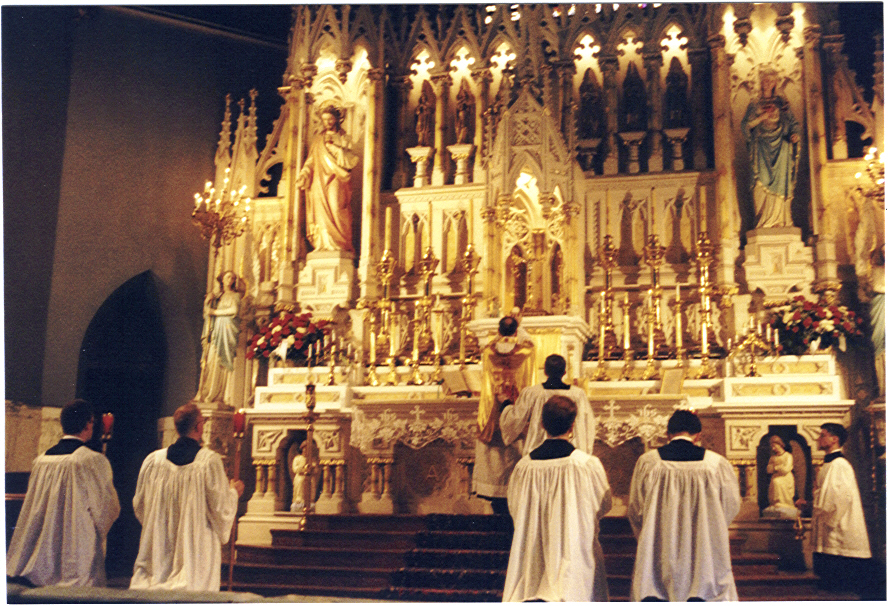
Bad priests and corrupt bishops there are in abundance, and always have been. But the Church is so much more: It is souls beyond counting. (Image: Church of the Gesu, Rome)
Welcome, Instapundit visitors. Light a candle while you're here, enjoy the smells and bells, and do come back again.
#
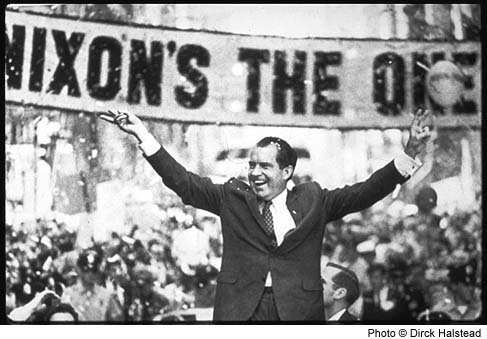
George Embrey loved the President.
Nixon had a habit, whenever he got into his helicopter at the airport, of going to the window for a moment and waving at the crowd. George Embrey [of the Columbus Dispatch] was the only member of the press who would always wave back.
"Goodbye," he would cry softly as the helicopter started to take Nixon away, "Goodbye!"
Embrey was a blank-faced, clean-cut man who wore white shirts, striped ties, neat suits, well-shined shoes; he spent a great deal of time at the National Press Club bar, soliciting votes to become the club's secretary. He liked pool assignments, and once blew up at Ziegler for not letting him follow Nixon out of the kitchen exit of a hotel. "My job is to stay with him at all times!" said Embry. What he really wanted, many of his colleagues thought, was to become a Secret Service man.
From The Boys on the Bus, by Timothy Crouse, 1972.
Sycophancy is unseemly in a journalist covering a president.
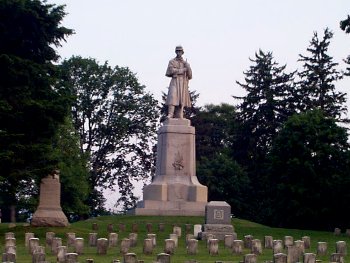
Private Soldier Monument, Antietam. The inscription reads: "Not for themselves, but for their country."
Sept. 17 marks the 140th anniversary of the single bloodiest day of battle in American history. On that day in 1862, near Sharpsburg Md., Robert E. Lee attempted to invade the North with a 50,000-man Confederate army that was intercepted at Antietam Creek by 70,000 Union troops under George McClellan. Lee would retreat after having lost 25 percent of his forces, including 2,700 dead and 10,000 wounded or missing. The Union prevailed, but at a cost of 12,000 casualties, including 2,108 dead.
In the Civil War, 618,000 soldiers died--2 percent of the American population, comparable to 5 million perishing today, writes Craig Lambert in a Harvard Magazine article, "Rifles and Typhus: The Deadliest War." All other American wars combined, through the Korean War, claimed fewer lives than the Civil War alone. In World War II, 30 out of every 10,000 men in uniform perished. Civil War combat was six times as deadly, killing 182 per 10,000. Based on 1860 census figures, 8 percent of all white males aged 13 to 43 died in the war, including 6 percent in the North and an extraordinary 18 percent in the South. Of 180,000 African Americans who served in the Union army, 20 percent did not survive.
And so to reparations: Boston Globe columnist Jeff Jacoby, in a two-part series on the issue (see Part I here), makes a compelling argument:
At its core, the reparations movement is racist; it treats all blacks as victims and all whites as villains. But all whites are not villains. From the day Africans arrived in America, there were whites who pleaded their cause and fought for their rights. Many paid dearly for their commitment to black freedom. Elijah Lovejoy, the fiery abolitionist editor, was murdered by a pro-slavery mob. William Lloyd Garrison, founder of the American Anti-Slavery Society, was jailed. Senator Charles Sumner of Massachusetts was beaten so severely it took him three years to recover.
Americans -- white Americans -- ultimately paid a horrific price to end slavery. The Civil War killed more than 600,000 men -- the death tolls of World War I, World War II, Korea, and Vietnam combined. The Union Army suffered staggering losses: 360,000 dead, 275,000 wounded. The social and economic impacts were catastrophic; the scars of the war lingered for decades. If slavery's awful debt has never been repaid, neither has the debt for freedom. It should be as plain to us as it was to Abraham Lincoln that the two debts cancel each other out.
"Fondly do we hope," he said at his second inauguration, "fervently do we pray, that this mighty scourge of war may speedily pass away. Yet if God wills that it continue until all the wealth piled by the bondsman's two hundred and fifty years of unrequited toil shall be sunk, and until every drop of blood drawn by the lash shall be paid by another drawn with the sword, as was said three thousand years ago, so still it must be said: 'The judgments of the Lord are true and righteous altogether.'"
We are one people -- descendant of slave, slaveowner, and liberator alike. We can accomplish nothing by confronting each other with demands for payment. Slavery was hideous. So was the war to end it. Can we not leave it at that, and strive instead to treat each other, as Lincoln urged, with malice toward none, with charity for all?
Rod Dreher writes in today's Wall Street Journal:Even if it has been possible to believe that John Paul had been ignorant of the rape of children, the worst of all scandals, that is obviously no longer the case. The situation of Catholics in Boston is enough to make one weep. Cardinal Bernard Law claims to have offered his resignation, only to have it refused. Rome allows him to remain in office, though his mendacity and corruption are there for all the world to see, and the credibility of the church in Boston is destroyed.
Who keeps him there, and why? Who retains in office a host of American bishops defiled by their indifference to the victims of depraved priests under their authority? Who could remove them with a stroke of his pen? It is hard to judge John Paul, because we don't know what he's had to fight behind the scenes. Still, I find it impossible any longer to give him the benefit of every doubt, as is the custom of many papal loyalists. John Paul must bear partial responsibility for the catastrophe that has befallen us.
When it comes to priestly pederasty, many American bishops have rejected moral law; thus, Catholic families have been attacked. The pope, alas, has no authority to obstruct the culture of death in the world, but that is not true within the church. Unless he takes dramatic action to restore the church to holiness -- starting with deposing this legion of bad bishops -- his criticism of modern society will ring hollow in the heart of this faithful American Catholic. And that is painful beyond words to say.
This thoughtful and powerful piece is not online today, so do pick up a copy of the Wall Street Journal to read it.
#
Monday, August 19, 2002 More on the Peace Abbey, Gandhi, &c
As of this morning, the noxious banner at the Peace Abbey in Sherborn had been removed. Don't know if aggrieved e-mails did the trick. But kudos to readers who took time to write in protest.
A rewarding aspect of the Peace Abbey screed business has been the light that several correspondents have shed on Gandhi's teachings -- the ones not emphasized at paper-crane-folding bees. My respect for his legacy has only been enhanced.
In the comments box below, Scott offers these quotes from the great Indian pioneer of non-violent resistance:
My non-violence does not admit of running away from danger and leaving dear ones unprotected. Between violence and cowardly flight, I can only prefer violence to cowardice. I can no more preach non-violence to a coward than I can tempt a blind man to enjoy healthy scenes.
Cowardice is wholly inconsistent with non-violence. Translation from swordsmanship to non-violence is possible and, at times, even an easy stage. Non-violence, therefore, pre-supposes ability to strike. It is a conscious deliberate restraint put upon one's desire for vengeance. But vengeance is any day superior to passive, effeminate and helpless submission.
Nonviolence is infinitely superior to violence. But the message of nonviolence is for those who know how to die, not for those who are afraid of death. If one has not that courage, I want him to cultivate the art of killing and being killed, rather than in a cowardly manner to flee from danger.
Rachel offers another useful Gandhi quote:
He who cannot protect himself or his nearest and dearest or their honor by non-violently facing death, may and ought to do so by violently dealing with the oppressor. He who can do neither of the two is a burden.
Meantime, Loretta Rogers of San Anselmo, Calif., e-mails a thought-provoking essay that proposes a campaign upon which pacifists might embark with some effect:
I would like to say something in favor of real pacifism specifically of the Gandhian variety. None of "peace abbots" that you cite seem particularly Gandhian to me, despite their statue.
M. Gandhi was an active opponent of evil. He was also grounded in reality and politically savvy. He had great moral stature and even his opponents respected him. Most of all, he tended to be effective.
His response to evil was to name it and then do something about it. He mounted campaigns that respectfully addressed all parties in a conflict and challenged them to change their minds and hearts. He got results.
In my view, today's peaceniks are passive and whiny. They take an ostrich approach to the threat of Islamist terrorism and address themselves petulantly to only one party in the conflict, the U.S. and its government.
Their writings and communications tend to be contemptuous of the feelings of outrage and patriotism in the American people. They oppose U.S. military action in a way that seems more like a rebellious adolescent rather than an adult making a reasoned judgment after taking full account of the realities of our present situation.
Therefore, I completely understand the contempt they elicit from you. Obviously, they change no one's mind and clarify nothing. To me, they seem less interested in pursuing peace than in pursuing a political agenda and appearing morally above it all.
Gandhi once discussed the range of responses a community could make to aggression and set up a moral hierarchy of options: The best option, of course, was Gandhian nonviolence. The second best option was to respond militarily, more or less following the just war guidelines. The worst possible option was to do nothing and to identify with the aggressor.
To me, the current "peace movement" seems to have chosen Gandhi's worst option. The Bush administration appears to have chosen the second best and thus the morally superior one. If "pacifists" were truly interested in promoting peace, they could follow Gandhi's lead and make a substantial contribution to resolving the present crisis.
Here's a project that would be very Gandhian and actually helpful:
I suggest that pacifists mount a campaign where they respectfully request that the Saudi king and the chief mullah of Mecca invite the Pope, the Dalai Lama and other leaders of the major religions to visit Mecca, pay their respects at the Kaaba, and speak at the main mosque in Mecca, each as representatives of his or her own faith tradition.
The campaign would consist of pacifists marching to the Saudi embassies all over the world, to local mosques and Muslim schools respectfully but persistently making this request. They would need to keep it up day after day over years. The initial response would be enormous outrage and confusion, of course. Muslims would start their usual accusations of racism, their rationalizations, obfuscation and verbal dueling.
It would, however, get Muslims to think and would prompt an ongoing dialogue. The advantage of such a request is that it would directly challenge Muslim intolerance and the symbolism would be immediately clear even to the most uneducated Muslim. The possibility of distortion by journalists and propagandists would be minimized.
This suggestion is modeled on Gandhi's 1922-24 Vikam temple campaign against the caste system. In it, Gandhian protestors, including untouchables, marched along a road from which untouchables were traditionally excluded to the door of a temple, asking for untouchables to be admitted. This was asking for the most unclean people to enter the most sacred place. It made the issue of untouchability immediately clear, even to illiterates.
The campaign took 2 years and was ultimately successful. When you consider that the Gandhians were challenging a religious teaching thousands of years old, two years of effort seems like a pretty short time. Also, I have read that in the aftermath of the campaign, the caste system was more effectively broken down in that area than in other parts of India.
This is the type of campaign that I could lend some support to. I would not see it as a substitute for military action, but as a way that pacifists could powerfully contribute. I think you could lend some support to this as well. There are lots of possibilities for campaigns that could make a big difference.
The Peace Abbey's eccentric vegan Quaker founder, Lewis Randa, has received coverage for manually hauling a one-ton slab of granite commemorating civilian casualties of war through parts of the United States, Ireland and England. He wears his politics on his sleeve, or rather, on his head, to judge from this report carried by the Indian Communist Party's house organ two weeks after 9/11:
In the wake of recent racially motivated assaults against Arab- and Muslim-Americans, Lewis Randa - the Peace Abbey founder, a conscientious objector during the Vietnam War - wears a muslim skull cap "to know what it’s like to be viewed as a threat to society." "It’s a despicable thing for Bush to say we will punish those who host terrorists. We hosted Tim McVeigh. Did we bomb his home state?" he questioned.
Boston Globe columnist Adrian Walker caught up with Randa at a peace demonstration at the abbey last October:
After the peace signs had been put away for the afternoon, Lewis Randa, the leader of the protest, talked about the frustrations of being a peacenik, post-Sept. 11.
With tears in his eyes, he said, "In 30 years of doing peace work, this is the loneliest it's ever been."
Randa was a conscientious objector to the Vietnam War, discharged from the Army after a 16-day fast. Though he had enlisted, he quickly became a pacifist.
But that was a different antiwar movement, in a different America. That was before the World Trade Center towers were attacked, before a section of the Pentagon was obliterated, and before the outrageous televised specter of Osama bin Laden declaring "holy" war against the United States.
Where protesters eventually carried the day in opposition to Vietnam, today's peace people are simply out of touch. After we stop the bombing, then what? Would that mean no more terrorist attacks? No more mailed anthrax?
To the peaceniks, this thinking could not be farther from the point. Randa suggested that perhaps the terrorist attacks should instead have been labeled terrorist "responses" - responses, he said, to unfeeling capitalist treatment of the Third World, as well as its blind support of Israel at the expense of Palestinian suffering.
He said Gandhi had opposed fighting Hitler, suggesting that it might have been better to allow the Nazis to take over Europe, then bombarding them with the message of love.
I pointed out that, in the overwhelming view of history, Gandhi and his fellow World War II pacifists couldn't have been more wrong. This is what I got in response: "Fifty-three million people died in that war. Is that your idea of a victory?"
That their founder is a doctrinaire leftist inspired to no small degree by anti-American animus would seem readily apparent. Yet the Peace Abbots' billing of themselves as conscientious seekers of peace and justice is so readily accepted at face value that local schoolchildren are dispatched to the Abbey for indoctrination. Can one imagine, say, the John Birch Society being given similar access to the public schools?
Mark Cameron, weighing in on the topic of missal revisions, eloquently argues that the '69, rather than the '62, ought to be brought more in line with the '65. Of the '65, which he describes as "a sort of halfway house between the traditional liturgy and Paul VI's radical revision of 1969," he writes:
Now actually, I think some of the proposed 1965 reforms were quite good. I have no problem, for example, with the Epistle and Gospel being read from the pulpit in the vernacular (as long as a decent translation is used - Douay-Rheims, Confraternity, or Catholic RSV - not the NRSV, please). Adding the "prayers of the people" was, I think, an appropriate change, and a restoration of medieval practice (although, again, in many Novus Ordo parishes this descends into weekly prayers for the advent of socialism or an exercise in group therapy -- some carefully written prayers for the Church, the dead, the sick, and civil society should be composed as models, leaving only one or two prayers to local discretion.)
But some of the other proposals seem misguided -- for example, the omission of the prayers at the foot of the altar (beginning with the "introibo at altare Dei", which people have known for centuries as the first words of the Mass), or of the Last Gospel (the prologue of the Gospel of John, perhaps the most profound text in the entire Bible) and the Leonine prayers at Low Mass (including the Prayer to St. Michael for protection from the devil, which is I think a salutary reminder of the powers of darkness in our age). These may be "extras" added to the rite over the course of the centuries, but they are good extras that only enhance and enrich the liturgy.
Bushmills was distinctly involved in the St. Patrick's Day of happy memory upon which I met my wife-to-be, so I read with pleasure this tribute by WSJ editorialist William McGurn to the most ecumenical of Irish whiskeys.
How to explain to the uninitiated the glories of this smooth amber fluid? Joyce wrote of "the light music of whiskey falling into a glass--an agreeable interlude." Samuel Johnson in his Dictionary defined whiskey as a "compound distilled spirit," adding that "the Irish sort is particularly distinguished for its pleasant and mild flavour." An old Irish toast gets straight to the point: "Too much of anything is good for nothing. Too much good whiskey is barely enough." Amen.
Though the Bushmills license dates to 1608 and King James I, Brian confirms that the Irish had been producing whiskey--spelled properly here, with an "e"--for perhaps a thousand years before that. How many Jack Daniel's or Johnny Walker drinkers, I wonder, appreciate that they owe their favorite tipple to the Irish monks, who in the sixth century brought back from the Middle East the alembic used to distill perfumes but soon adapted it to much more felicitous use? Thus the still was born.
Friday, August 16, 2002 Cosseted Suburban Yogis Deserve a Good Fisking
My morning drive to work takes me through Sherborn, Mass., past the Peace Abbey, with its Pacifist Memorial statue of Mahatma Gandhi, and where this week, prominently displayed to capture the attention of all motorists at the busy intersection of Routes 16 and 27, has been placed a billboard-style banner:
I’m not sure what reaction the Peace Abbots are seeking. But the banner does not stir in me the dewy glimmer of pacifist feeling. Quite the opposite.
It gets me thinking about the Hansons, of Groton, Mass., and their beautiful little two-year-old daughter, Christine, heading on vacation to California aboard United Airlines Flight 175 on Sept. 11.
It gets me thinking about Neilie Heffernan Casey, Holy Cross '90, a passenger on American Flight 11 that day, and about the six-month-old daughter she left behind.
It gets me thinking about Dan McNeal, Boston College '94, lost at the World Trade Center, who was remembered in the Baltimore Sun this month, and in whose childhood photos I see my own sons.
It gets me thinking about Welles Crowther, Boston College '99, lost at the World Trade Center, an equities trader and former college lacrosse player who was a volunteer fireman. Friends sometimes teased him about his longstanding habit of always carrying a red bandana in his back pocket. Survivors who escaped from the 78th floor of the South Tower told of an unknown man who stepped out of the smoke and horror and shepherded them to safety – a man with a red bandana wrapped around his mouth.
The banner gets me thinking about little Gal Aizenman, five years old, killed at a Jerusalem bus stop. It gets me thinking about Daniel Pearl, whose newborn son will never know his father.
The banner gets me thinking about my own three precious children. And that there are madmen afoot who would harm or kill them – and who no doubt are planning attacks right now intended to kill or maim thousands of innocents like them.
And then I think of how the people who hung that banner would have done nothing to respond to the murder of 3,000 innocent Americans on 9/11 and would do nothing to prevent any further attacks planned. They would do nothing to stop psychotic death cultists who, for twisted reasons beyond understanding, want to kill your children and mine.
Meantime, they degrade the sacrifice and bravery of this nation’s men and women in military service.
The people who hung that banner are equating self-defense against assassins with the murderous acts of the assassins. They promote not justice, not peace, but a lie.
Perhaps the Peace Abbots can’t discern between darkness and light. Perhaps they can, but see sanctimony and appeasement as the responses to brutal aggression. Perhaps they are irretrievably afloat in cloud-cuckoo land mulling their passages from Dorothy Day, John Lennon and Samantha Smith.
Or perhaps these suburban Sufis are the East Coast version of Johnny Walker’s Marinated Mahatmas, animated by a leftist loathing for the American society that allows them to freely voice their opinions from a cozy ashram in one of the priciest communities (average property value $505,621) in Massachusetts.
Whatever the case, what they’re preaching is not noble. It is not brave. It is contemptible.
Chesterton put it well when he described pacifists as "the last and least excusable on the list of the enemies of society."
They preach that if you see a man flogging a woman to death you must not hit him. I would much sooner let a leper come near a little boy than a man who preached such a thing.
The Peace Abbots are entitled to their opinion, of course, this being a free country (though it would not be for long, one imagines, if their counsel were followed).
But since they have seen fit to foist their position on thousands of motorists daily, a public response in the form of a thorough e-Fisking would be appropriate.
Here’s the Peace Abbey’s contact page. E-mail and tell them they ought to be ashamed of themselves. And suggest what they can do with that sign.
Wednesday, August 14, 2002 What a spectacle for heaven and earth is not the Church at prayer!
For centuries without interruption, from midnight to midnight, the divine psalmody of the inspired canticles is repeated on earth; there is no hour of the day that is not hallowed by its special liturgy; there is no stage of human life that has not its part in the thanksgiving, praise, supplication, and reparation of this common prayer of the Mystical Body of Christ, which is The Church. Pope Pius XI
The Saint Gregory Society of New Haven is a lay association that promotes the Traditional Latin Mass, regularly celebrated at Sacred Heart Church in that city. The society supports a professional Schola Cantorum that provides the proper Gregorian chant and sacred polyphony for all sung liturgical functions. A selection of magnificent recordings – accompanied by online samples – is available at the website.
Never since its founding has Israel been in such dire peril. The Israel-Arab conflict is being fought not just in the Middle East. It is being fought right here in America, and worldwide – with a sophisticated propaganda campaign whose techniques were learned from the experts…In defending Israel, we are defending our civilization. The outcome of this fight will affect the larger war on terrorism; it will determine what kind of world we, our children and our grandchildren live in for generations to come. Click here to learn how to support David Horowitz's Defense of Israel campaign.
Daniel Doron writes at National Review Online: The Arabs have successfully pilloried Israel in the court of public opinion through the deft propagation of two big lies. Relying on the sketchy historical knowledge of most people, and on the propensity of oft-repeated lies to become accepted wisdom, Arab officials have fabricated a historical narrative that has gained wide acceptance. It justifies Arab aggression, even terror, as an understandable response to cruel Israeli "occupation" and to the "stealing of Palestinian lands." The charges often stick, even though they are based on falsehoods. #
David Brudnoy writes: Equivalency is au courant in Boston. Its avatars insist that those who blow up innocents are no worse than those who send their soldiers to apprehend the perpetrators. Equivalency is beloved by James Carroll, the former priest turned preacher to the world at large. In several articles, Carroll has concocted a neat two-fer, as in "Ariel Sharon has duplicated the Bush approach" - the US search for Osama bin Laden "no matter the consequences to the world" - "laying siege to whole Palestinian towns, terrorizing the innocent while efficiently recruiting yet more suicide murderers for Hamas, earning from Bush the sobriquet 'Man of Peace'. It takes one to know one."
To Carroll, the crux of the problem is America's unwillingness to clamp down on Israel. The Arabs "are howling at us, and with cause." The US and Israel are the problem. Can't everyone just get along? Equivalency theory insists that the presence of Israel in what Defense Secretary Donald Rumsfeld correctly refers to as the "so-called territories" it fell heir to after Jordan went to war against it (again) in 1967 is the same as Hitler's occupation of Europe. Equivalency theory considers Palestinian mass murders and then gloating over their barbarism no different than Israel's accidental killing of civilians when they go after the killers. This is the fashionable lunacy.
Visitors unfamiliar with the late William A. Henry III might wish to consult this useful reading-group guide to his provocative book In Defense of Elitism, which carries this descriptive blurb:
From the Pulitzer Prize-winning culture critic for Time magazine comes the tremendously controversial, yet highly persuasive, argument that our devotion to the largely unexamined myth of egalitarianism lies at the heart of the ongoing "dumbing of America."
Americans have always stubbornly clung to the myth of egalitarianism, of the supremacy of the individual average man. But here, at long last, Pulitzer Prize-winning critic William A. Henry III takes on, and debunks, some basic, fundamentally ingrained ideas: that everyone is pretty much alike (and should be); that self-fulfillment is more imortant than objective achievement; that everyone has something significant to contribute; that all cultures offer something equally worthwhile; that a truly just society would automatically produce equal success results across lines of race, class, and gender; and that the common man is almost always right. Henry makes clear, in a book full of vivid examples and unflinching opinions, that while these notions are seductively democratic they are also hopelessly wrong.
Critical praise:
"A wide-ranging, free-swinging commentary that will raise the hackles of nearly everyone." New York Times
"In Defense of Elitism not only doesn't suffer fools gladly, it twists their tiny fluttering wings off." The New York Observer
"Bill Henry was one of the toughest, smartest, and most original men of letters in our generation. In Defense of Elitism shows him at his most provocative and controversial. Even when I disagree with his arguments, I admire the rigor of his thinking, the style with which he sets these ideas forth. A fitting memorial to one of our most original minds." Henry Louis Gates Jr., chairman of the Afro-American Studies Department and director of the W.E.B. DuBois Institute for Afro-American Studies at Harvard University, and co-editor of Encyclopedia Africana.
Those inclined to anger at Henry's premise – and his is an incendiary work – may wish to join Skip Gates in actually reading the book before forming an opinion. Of course, it does save time to dismiss out of hand ideas one finds offensive – or that one thinks one will find offensive, not having actually engaged them. Just ask the sensitivity mavens in the Diocese of Lafayette, La.
An essay by Father Joseph Fessio, SJ, offers some remarkable details you may not have known about the Catholic liturgy. On the question of Mass ad orientem vs. versus populum:
The Council did not say that Mass should be celebrated facing the people. That is not in Vatican II; it is not mentioned. It is not even raised in the documents that record the formation of the Constitution on the Liturgy; it didn’t come up. Mass facing the people is a not requirement of Vatican II; it is not in the spirit of Vatican II; it is definitely not in the letter of Vatican II. It is something introduced in 1969.
And, by the way, never in the history of the Church, East or West, was there a tradition of celebrating Mass facing the people. Never, ever, until 1969. It happened occasionally in Germany, in between the wars; it was done sometimes at the castle where Romano Guardini would have his group of students meet; it was done in Austria near Vienna by Pius Parsch in a special church, in what he called a “liturgical Mass.” That’s an odd expression, a “liturgical Mass.” The Mass is the liturgy.
But in any event, I can say without fear of contradiction from anyone who knows the facts that there is simply no tradition whatsoever, in the history of the Church, of Mass facing the people. Now, is it a sin? No. Is it wrong? No. Is it permitted? Yes. It is required? Not at all. In fact in the Latin Roman Missal, which is the typical edition that all the translations of the Missal are based on (not always translated properly, but at least based on it) the rubrics actually presuppose the Mass facing East, the Mass facing the Lord.
Now, for the first 25 years of my priesthood, I celebrated Mass like you see it when you go to a typical parish: in English, facing the people. It can be done reverently; I’ve seen it done reverently; I’ve tried to do it reverently myself. But the last three years, after study and reflection, I’ve changed. I actually think the Mass facing the people is a mistake. But, even if it’s not, at least this much we can say: there is no permission required to say Mass facing God, facing the tabernacle, facing East, facing with the people. And it should be given equal rights, it seems to me, with Mass facing the people. It’s been around for 1800 years at least, and it should be allowed to continue. I happen to think it’s symbolically richer.
And on Gregorian chant:
I called this wonderful rabbi in Manhattan and we had a long conversation. At the end, I said, “I want to bring some focus to this, can you give me any idea what it sounded like when Jesus and his Apostles sang the Psalms?” He said, “Of course, Father. It sounded like Gregorian Chant. You got it from us.”
I was amazed. I called Professor William Mart, a Professor of Music at Stanford University and a friend. I said, “Bill, is this true?” He said, “Yes. The Psalm tones have their roots in ancient Jewish hymnody and psalmody.” So, you know something? If you sing the Psalms at Mass with the Gregorian tones, you are as close as you can get to praying with Jesus and Mary. They sang the Psalms in tones that have come down to us today in Gregorian Chant. (Link via Confessions of an Accidental Choir Director)
Shawn Tribe's impressive site features a running discussion on the 1962 Missal and its potential for use in an updated version. Mr. Tribe writes:
There is another liturgical tradition within the Church; the multiplicity of rites. Hence, another possibility is if the 1962 missal could be left "as is" with the exception of the calendar of saints (which I think we all agree needs to be updated); perhaps one could propose this as one particular usage of the Roman rite, along side a reform of the reform as well as an adapted form of the 1962 Missal such as is being discussed. Too often we get caught into this homogenized post-Tridentine mould that there must only be *one* form of the Roman liturgy and everyone seems to suffer for it. Variations continue to work for the East and local variations were long part of the West. The Sarum use was one example of a particular English usage of the Roman rite -- as was the Hereford and York Missals. If this was fine then I do not see why it would be implausible or "un-Catholic" to propose the co-existence of different uses of the Roman liturgy once again -- provided they are in keeping with the tradition and are living liturgies (insofar as the Calendar goes I mean). #
In Support of the Melting-Pot
A thoughtful correspondent comments below that the recent give-and-take in these precincts on multiculturalism has been marked by a Cool Hand Luke-esque failure to communicate.
He may well have a point. So here's what I'm trying say:
In my opinion, the individual is more than his skin-color, or his ethnic affiliation, or his membership in a particular census group. I'm for the old-fashioned idea of the American "melting pot," out of which many have been assimilated into one, not the "multicultural" view of a county of many ethnic cultures separate from one another. And in my view, the emphasis on "diversity" as measured by skin color or sex or sexual orientation, under the assumption that all of a particular group share the same culture and beliefs, has led to an enforced conformity of opinion among the supposed thinking-classes in colleges and the media.
There is a terrible sense of sadness that I feel about what diversity has become in America, because the original goals of the civil rights movement were so clear, so moral, so accessible to everyone: namely, that people would not be judged on the basis of color, but rather on the content of their character. It's sad that this has been so turned on its head.
What happens on college campuses, and in all too many areas of American life, is that those who call themselves advocates of diversity actually want the reverse. They want people who are dark-skinned to think one way, and they want people who are Indian to think another, and they want people who are Asian to be only interested in Asian things. They want everybody who is of a certain ethnic background to stand for only that. And, it is such a narrow and limiting thing to do to people. It's great if you celebrate your own heritage, but it's also great if you view the inheritance of human civilization as your inheritance because you're human. That is what universities do when they're at their best.
Linda Chavez writes of the intellectual ghettoes that have been created in the name of diversity, and the fruits of a multiculturalism that teaches ethnic group allegiance takes precedence over allegiance to the United States.
The Catholic Church, which spent hundreds of years trying forcibly to convert Jews to Christianity, has come to the conclusion that it is theologically unacceptable to target Jews for evangelization, according to a statement issued yesterday by organizations representing US Catholic bishops and rabbis from the country's two largest Jewish denominations, the Boston Globereports.
On the Catholic-Jewish ecumenical front: Mark Shea (here and here and here) and Joe Katzman offer a conscientious and large-spirited approach to respecting another's faith and your own at the same time. Their essays on acknowledging God at work in those who do not share your creed are worth any six seminars on interfaith dialogue you could take at your local college. Do read them.
Felt a little older on reading the sports pages of today's Boston Globe:
Remember Gordie Lockbaum? In the 1980s, he put Holy Cross on the college football map by becoming a Heisman Trophy candidate and being featured in Sports Illustrated.
Last night, Lockbaum's son, also named Gordie, gave Worcester another memorable sporting moment. Lockbaum, a 12-year-old shortstop, smacked a solo homer in the bottom of the third as his Jesse Burkett Little League team won the New England title with a 1-0 victory over Portsmouth, R.I.
Under the consecrated stone of Old Saint Mary’s high altar lie the relics of bones and a vase of blood of St. Martura (Latin for martyr), an unidentified first century Christian martyr. These relics were taken from her tomb in the Catacombs of St. Priscilla in Rome on January 24, 1844.
On the Feast of the Annunciation, of that same year, they were solemnly placed by Bishop John Baptist Purcell under the main altar for public veneration. There they have rested undisturbed for 154 years. On September 14, 1879, Pope Leo XIII granted a special spiritual concession to Old St. Mary’s Church. He gave the high altar "privileged" status. A privileged altar is one to which the Holy See has attached a plenary indulgence applicable only to the souls in Purgatory. Every time a Requiem Mass is offered on such a privileged altar a plenary indulgence is gained for the deceased for whom the Mass is offered.
Painted on the base of the high altar, below the glass reliquary are the words, altare privilegiatum, "privileged altar."
The Treasured Churches of Cincinnati: A beautiful collection of architectural histories assembled online by Rev. Donald Tenoever,
Michael S. Rose, and Robert A. Flischel.
About a decade ago, one of the Smithsonian museums here in Washington had an exhibit on the history of human civilization, or something along those lines. I didn't see it, but a friend of mine went and his description always stuck with me. One of the displays was a comparative timeline of different cultures. At, say, 1250 you'd see what the British, the Japanese, the Chinese, or the Arabs had come up with. The sight that really struck home for my friend was a beautiful Renaissance Italian clock, with movable gears and a stunning hand-painted face with a sun and moon alternating for AM and PM. The clock came from the 15th or 16th century, I think. But that's not really important. On the same timeline for African culture there was a wood mask with eye- and mouth-holes cut out in some "novel" way. The little explanatory card on the wall tried to make it sound, somehow, as though the handcrafted clock and the mask were similarly impressive accomplishments. To which my friend responded, roughly, "Are you high?"
I may have gotten the details a bit off here, but the substance is obviously true. Some things are better than other things. Some cultures are better than other cultures. Some things are more worth studying, celebrating, and emulating than other things. Or as the late William Henry III put it in his wonderful book, In Defense of Elitism, "It is scarcely the same thing to put a man on the moon as to put a bone in your nose."
A reader asks:I have a question that's always intrigued me: the layout of the Anglican churches where the congregation sit face to face (or maybe it's the choir; I'm always confused). Where did this layout come from? Was it widespread throughout the rest of Europe? If not, why not?
Father James Tucker responds:He's describing choir seating, which is set up in that way to facilitate the antiphonal (that is, the alternating of sides) singing of the Psalms at the Canonical Hours. The liturgical choir isn't the people who sing great polyphony, but rather the clerics who sit in the area that we would roughly call the "sanctuary" to sing the Hours or to assist at Mass. Just about any monastery, as well as most seminaries, will have the seating arranged in that way. I imagine that the places [he] is describing have arranged their congregational seating to mimic that of the liturgical choir. Recall that up until about the time of the Reformation, there weren't any seats or pews for the congregation. If you go to Rome today, you'll still find that all the great basilicas have very temporary congregational seating, easy to move around as needed, or to remove altogether to avoid clutter. So, there really isn't a lot of precedent one way or the other for how to seat the people.
Barbara Ryland responds:Most churches are (or used to be) built in the form of a cross (i.e., they are cruciform), and are supposed to face East towards Jerusalem (if you are in Europe, of course). The place where the worshipers sit, and used to stand, is known as the nave. The altar is just past the "crossing" of the transepts (the north-south axis, or "arms" of the cross). The place behind the altar -- or the "head" of the cross -- is known as the choir, at least in English cathedral churches. According to a site that I found, the choir did have chairs, especially after the reformation, where non-hoi polloi worshipers could sit and attend the services, while ordinary folk stood in the nave like they always had. Pews are a modern invention. It has been more than 10 years since I visited a service at St. Paul's Cathedral in London, but I believe it is laid out thus. Traditional Episcopalian/Anglican churches in America were built in the shape of a cross and face East. There are some lovely examples in Eastern Virginia (maybe even the Old Falls Church -- but this has been added on so much you don't really see it as a cross).
"How can a simple Jew like myself show his love of God?" Read the moving story of Abe Avremel Zelmanowitz, "saint of the burning towers," who in death magnified and sanctified the name of the Lord. (Link via Mark Shea.) Visit a tribute page here.
#
"Nothing could be less Catholic than to think the way
our churches look has no effect on our spirits.
"Nothing could be more Catholic than to use the physical renewal of our churches to aid in the spiritual renewal of our Church." Emily Stimpson, with characteristic elegance, makes the case for beauty in Catholic worship.
Roses, Fountains, and Gold: The Virgin Mary in History,
Art, and Apparition
An extensive and beautifully written study of the role and influence of the Blessed Virgin Mary in history, art and apparitions throughout the 20 centuries of Christianity. Beginning with Mary's significance in the early Church and the writings of the Church Fathers, the author moves on through Church history showing her inspirational role in building vast numbers of cathedrals; how the rosary and scapular came to be; the story of her intercession in the critical battle of Lepanto; Mary in the writings of poets like Dante and Donne, in the music of great composers like Schubert, in the paintings of the great masters and in the sculpture of Michelangelo.
Finally, it gives an in-depth look at the story and message of each of her eight great apparitions in the period from 1830 to 1933. This is truly a work of inspiration that will leave the reader in awe and wonder at the incredible grace, mercy and love that God has bestowed on mankind through the person of Mary, his mother.
Sample this book from Ignatius Press by John Martin, whose poems and essays have appeared in First Things, Chronicles, The Sewanee Review, The Christian Century, and The Chesterton Review. Not to mention The Remnant. And whose talents as a writer, to judge from his poems that have been published in First Things, here and here, as well as the odd letter to the editor, here and here, are substantial.
A new round in the "War of the Rose"? Fr. Rob Johansen of Thrown Back is to be interviewed Thursday, Aug. 8, at 4 p.m. EDT on the Al Kresta Live show on Ave Maria Radio. The subject: Fr. Johansen's criticism of the Michael Rose book Goodbye! Good Men. Listen to a live webcast here.
In a packed St. Peter's Square on October 6, barring fire, flood, crocodiles in the Tiber, or the remake of Ben-Hur, the late Monsignor Josemaria Escriva de Balaguer, the controversial founder and guiding spirit of Opus Dei, will be declared a saint – a certified, bona fide, and prayer-answering citizen of Heaven. While this swift and improbable canonization will no doubt exhilarate Escriva's followers, it will just as certainly exasperate his foes, set a vexing precedent, and raise fresh questions about papal infallibility. With apologies to Shakespeare, even if the graves don't stand tenantless while the sheeted dead squeak and gibber in the Roman streets, the shock waves will be felt from Michelangelo's dome to the crypt of Athanasius.
It's not simply that Escriva and Opus Dei have a legion of critics and a history of dubious practices, it's the startling pace John Paul II has followed in exalting this mysterious shepherd and his multinational flock through a series of breathtakingly honorific 10-year milestones -- granting Opus Dei personal prelature status (1982), beatifying Escriva (1992), and now (2002) declaring this dynamic but disturbing son of Spain worthy to rub elbows with such giants as John the Baptist, Peter and Paul, Joan of Arc, Thomas More, Therese of Lisieux, and Christina the Astonishing. And truly, if there's anything more astonishing than St. Christina, who climbed trees, hid in ovens, and even flew into the rafters of a church to avoid sinful human contamination, it's the record speed with which Escriva (1902-1975) will have won his heavenly spurs: a mere 27 years from coffin to choir. But there it is -- Roma locuta est and no angry letters, please. Advocates of the old-fashioned wait and see, devil's advocate school of saint-anointing may stage massive protests and submit petitions swarming with signatures, but nothing short of divine intervention is likely to head off what promises to be the most audacious canonization of modern times…
The present elevated status of Escriva and Opus Dei is of course only one of many astonishments in the brave new Rome of 2002 -- this increasingly vulnerable "temple" that a number of very human "leopards" have been breaking into ever since the Second Vatican Council opened the windows and let in the so-called fresh air of dialogue, collegiality, and ecumenism. If the leopards have not yet drunk the sacrificial chalices dry, they have at the very least left their paw prints all over the altar with their liturgical novelties and Bob Dylan Eucharistic Conferences, their Assisi brotherhood fests, their shell-game antics in the matter of Fatima, and their brazen disregard for the rights and rituals of classic Catholicism.
To be sure, Escriva and Opus Dei represent a leopard with a very different pattern of spots and manner of operating. Whereas the others have generally been diluters of the sacrificial chalices -- adding the pale water of liberalism to the good wine of orthodoxy -- Escriva and Opus Dei have brought an additive of unmistakable potency: Serviam, the spirit of true believers. Here are people who look, act, and sound like the solid old Catholics of yesteryear -- in fact, more so. And that's just the problem: in their scrupulous adherence to the fierce and narrow demands of their humorless and superorthodox prelature, Opus Dei members inevitably become more "Catholic" than Catholicism -- especially in the respective matters of self-discipline, spiritual direction, and reverence for authority. And nowhere is that reverence more evident than in the unthinking, uncritical, and virtually Maoist way they praise and quote the man variously called "the Father," "Our Father," and "the Founder."
Now, it seems, they'll also be calling him "the Saint." And whether they'll be calling him that in truth or misbelief is a matter of the gravest concern, notwithstanding the dictum of Thomas Aquinas that infallibility is not involved in a papal pronouncement based on noninfallible "fact." It remains that heresies are temporary and canonizations are permanent, and if Rome is wrong about Escriva, the error will forever taint the whole idea of sainthood, to say nothing of destroying trust in the keys of Peter…
More on the not-so Shadowy Tradition: Joseph Sobran is considered by Fr. Richard John Neuhaus in "Jews, Christians, and "The Great Fear," from the October 1994 edition of First Things.
#
World Youth Day offered plenty of opportunities to do penance, if your tastes in sacred music ran to the traditional rather than Bubble-gum Pop or Christian Rock 'n Rap. Aristotle Esguerra, Catholic music director at Cornell, offers an informative and entertaining (or cringe-making, depending on your perspective) in-person Music Report from Toronto, where "orthodox" equaled Kumbaya.
#
Mother Teresa's Secret:"Not very long ago I said Mass and preached for…Mother Teresa of Calcutta, and after breakfast we spent quite a long time talking in a little room. Suddenly, I found myself asking her -- don't know why -- 'Mother, what do you think is the worst problem in the world today?' She more than anyone could name any number of candidates: famine, plague, disease, the breakdown of the family, rebellion against God, the corruption of the media, world debt, nuclear threat, and so on. Without pausing a second she said, 'Wherever I go in the whole world, the thing that makes me the saddest is watching people receive Communion in the hand.'" Fr. George Rutler, 1989
Mother Teresa would not have enjoyed the Neocatechumenal liturgy as described by a former NC seminarian:
One of the more peculiar elements of the NC Liturgy is that the community remains seated to receive Communion on the hand only. On one occasion I saw a member of a young community who, kneeling to receive Communion on the tongue, was told to be seated and to place his hands out in front of him if he wished to Communicate! After receiving the Body of Christ on the hand, all Communicants refrain from eating until the priest returns to his place.
Ecce Egnes Dei. The priest returns to his seat and says 'This is the Lamb of God .... called to his supper. May the Body of Christ bring us to everlasting life. 'At this point all Communicants begin to eat their portions.
Domine, non sum dignus ... et sanabitur anima mea. This response has also been omitted from the celebration. I can not comment on why this omission has taken place but the attitude of the catechists seems to be that, no matter how sinful we are, if we have been invite to a meal we should eat. Hence, Spiritual Communion is not encouraged.
The priest is given the chalice (either by an acolyte or the responsible) and says 'May the Blood of Christ bring us to everlasting life.' He then distributes the Precious Blood, starting with any concelebrating priests and acolytes and then to the cantor, who begins the next Communion song as the priest moves around the assembly once again.
There are two points of interest here. The first of these is that all of the bread that is consecrated must be consumed during the celebration. This is easily done if the community is large because there are sufficient numbers to consume any excess. However, I know of an instance in which less than a dozen people gathered for the Eucharist and were forced to consume quite large portions because someone had cooked enough bread to feed thirty or more people. Because of the 'slab' in front of each individual, the mainly young gathering giggled and laughed as they ate! The second point of interest is the relatively high chance of spilling the Precious Blood in this method of distributing Communion. Under normal circumstances (i.e. at the community level), the priest has the task of simply navigating his way down stairs and between rows of chairs in order to distribute Communion. But, in a Mass celebrated in the Cathedral of Perth, Australia, on the feast of the Assumption, 1996, I witnessed something beyond ridiculous. The catechists insisted that Communion be given under both species in the normal NC manner, meaning that the priests and acolytes had to distribute, not only the Body of Christ, but the Precious Blood to people in their pews!…
CONCLUDING RITE The concluding rite is identical to that of the Novus Ordo. When the priest gives the dismissal, a cantor moves to the lectern and begins the final song. The priest reverences the altar on his way in the normal manner. On special occasions the community will begin to dance around the altar once the priest has made his exit… #
Me, I believe hatred of the Jews is just old sin--part of the mysterious "shadow tradition" that pursues the Church through history as the spirit of antichrist plies his trade. It is a sin very close to the heart of Satan--if that black negating void can be called a heart.
To which a reader comments:Anti-semitism is the fingerprint of Satan.
The "shadow tradition" emerges in the accompanying comment thread.
Nothing shadowy, though, about the sentiments expressed by these Hamas supporters cheering the latest round of terror attacks on Israel.
There are those in America and Europe who would do nothing to stem Islamist terror, whose response to psychotic death-cultists who wish to kill our children consists of apology and appeasement. Their message: The Jews are to blame. They have it coming. The US is to blame. We have it coming.
If you've seen The Best Years of Our Lives, you remember the scene in the soda fountain when the veteran sailor who lost both hands in the war gets into it with another customer, an America-Firster of the Charles Lindbergh school, who says the war was misguided.
Customer: You got plenty of guts. It's terrible when you see a guy like you that had to sacrifice himself - and for what?
Homer: And for what? I don't getcha Mister?
Customer: ...We let ourselves get sold down the river. We were pushed into war.
Homer: Sure, by the Japs and the Nazis so we had...
Customer: No, the Germans and the Japs had nothing against us. They just wanted to fight the Limies and the Reds. And they would have whipped 'em too if we didn't get deceived into it by a bunch of radicals in Washington.
Homer: What are you talkin' about?
Customer: We fought the wrong people, that's all. (Pointing at his newspaper, with headlines: "SENATOR WARNS OF NEW WAR") Just read the facts, my friend. Find out for yourself why you had to lose your hands. And then go out and do something about it. (Source: www.filmsite.org)
Which is where Dana Andrews, the veteran pilot turned soda jerk, jumps the counter and gives the nativist spokesman for "plain, old-fashioned Americanism" a well-deserved sock in the mouth.
As Saddam readies biological weapons for use by the Palestinians, we again hear the refrains heard in the 1930s, when Oxonians debated the merits of fighting for king and country while the Axis grew in strength; when the smart set largely ignored – or considered self-induced – the plight of the Jews, and favored concessions to fascism in the name of peace. From the inimitable Michael Kelly.
In 1942 George Orwell wrote this, in Partisan Review, of Great Britain's pacifists:
"Pacifism is objectively pro-Fascist. This is elementary common sense. If you hamper the war effort of one side you automatically help out that of the other. Nor is there any real way of remaining outside such a war as the present one. In practice, 'he that is not with me is against me.' "
England's pacifists howled, but Orwell's logic was implacable. The Nazis wished the British to not fight. If the British did not fight, the Nazis would conquer Britain. The British pacifists also wished the British to not fight. The British pacifists, therefore, were on the side of a Nazi victory over Britain. They were objectively pro-Fascist.
An essentially identical logic obtains now. Organized terrorist groups have attacked America. These groups wish the Americans to not fight. The American pacifists wish the Americans to not fight. If the Americans do not fight, the terrorists will attack America again. And now we know such attacks can kill many thousands of Americans. The American pacifists, therefore, are on the side of future mass murders of Americans. They are objectively pro-terrorist.
Interesting thread on the Neocatechumenal Way at Free Republic: The Catholic Encyclopedia defines Gnosticism as the doctrine of salvation by knowledge, its adherents considering themselves "people who knew," whose "knowledge at once constituted them a superior class of beings, whose present and future status was essentially different from that of those who, for whatever reason, did not know."


![[SMMMHDH]](http://www.mgilleland.com/music/smmmhdh.png)