"He instinctively can find the shining greatness of our American culture and does a good job of highlighting it (although he also does have those rare lapses when he writes about hockey, but that is something caused by impurities in the Eastern waters or something)." Erik Keilholtz
Under the patronage of St. Tammany
Mark C. N. Sullivan is an editor at a Massachusetts university. He is married and the father of three children. Email
For the past 25 years, Felos has practiced yoga and meditation as a means to advance his spirituality and career. And while he lectures on "practicing non-attachment," Felos has made a good living along the way attaching sizeable legal fees to his bank account.
Critics of Felos and Michael Schiavo claim a significant portion of funds awarded for the care of Terri Schiavo have actually been absorbed in legal fees paid to Felos. As Wesley Smith, author of Forced Exit: The Slippery Slope From Assisted Suicide to Legalized Murder and frequent NRO contributor, says, "I find it bitterly ironic that the bulk of the money a medical-malpractice jury awarded to Terri for use in making her better instead went into Mr. Felos's pocket to make her dead."
Felos describes his spiritual beliefs as syncretistic religion, mixing elements of Christianity, Buddhism, Hinduism, and Native American ceremonial practices. In Litigation as Spiritual Practice's introduction, he declares, "evolution of consciousness is our ultimate salvation."
His apparent lack of concern for Terri Schiavo's plight might be better understood in the context of his belief that "[i]n reality you have never been born and never can die."
As the pope is put on a feeding tube, it's worth noting the exemplars of hundreds of years of Catholic teaching in this area are the elderly Eskimo on the ice floe and the Spartan baby left on a hillside to die. So suggest theologians:
In the pope's speech, delivered March 20 of last year to a group of doctors, ethicists and scientists from 40 countries, he argued that a sick person, even in a vegetative state, "still has the right to basic health care (nutrition, hydration, cleanliness, warmth, etc.) and to the prevention of complications related to his confinement to bed."
The speech stunned many Catholic theologians, who said it was a distinct break from 400 years of Catholic moral tradition that held that a medical procedure was obligatory only if it offered hope of checking or curing a disease.
"We've had a longstanding tradition that you can't kill, but you can remove that which prolongs your dying," said the Rev. James Keenan, a professor of theological ethics…"The big question is, what will the Vatican take off the list of extraordinary means next?"
Stunning, indeed: Clean sheets, warmth, food and water, checking for bed sores – what next on the slippery slope?
* * *
A Florida bioethicist comes out and says Terri Schiavo is not a person.
One expert told the New York Times that “no one is denying this woman food and water.” Really? Then why is she dying? Is it merely a coincidence that she might experience kidney failure from dehydration at any time?
This expert’s argument is that, since she is in a persistent vegetative state, she has “no knowledge of food.” By this logic it would be morally acceptable to suffocate her with a pillow since she has “no knowledge of air.” She could be dropped out of a 15-story window because she has “no knowledge of gravity.” She could be shot because she has “no knowledge of ballistics.”
The Schiavo case isn't just about Tom DeLay, right-wing Republicans in Congress and crackpot right-to-lifers, though you tend to get that impression from the Beltway pundits, the papers and the TV news.
Personally, I don't give a fig about Tom DeLay. If he were to be replaced in the Republican leadership, that would be fine by me. I will say there is no comparison between the case of his father, grievously wounded and sustained by machines, and that of Terri Schiavo -- notwithstanding the flawed premise of the latest media spin cycle.
The press coverage of Terri Schiavo has been so wrongheaded, so distorted, as to defy belief. This isn't a "right-to-die" case, as it's put in all the poll questions that purport to show 80 percent of Americans favoring Terri Schiavo's death. This is a "right to kill" case, a euthanasia case, a case of "mercy killing," if you like.
She isn't dying; she's being put to death. Between not impeding someone's natural death and causing someone to die, there's a world of difference, Rabbi Marc Gellman has observed. Terri Schiavo wasn't at death's door. Death's door was brought to her.
And yet this distinction seems lost on the press. Where are the copy editors? It's as if the heirs of Emily Litella had donned eyeshades and were running the assignment desks at all the big papers and news stations.
So the great lesson from all this is that we should make living wills? From now on we should be sure to put it in writing that we should prefer not to be killed?
Nat Hentoff, a self-described atheist and a Village Voice institution, describes the mainstream press' handling of the Schiavo story as scandalous, the worst case of journalistic malpractice he's seen in 50 years in the business.
Todd Flowerday suggests St. Blog's is losing its mind over a case that may, at its root, stem from a family falling-out over money.
Obviously, we don't know all the family dynamics at work in the Schindler-Schiavo rift, and a row may well have taken place over money. But as a parent, I am not convinced that purely venal reasons compel a mother and father to try to prevent their daughter from being killed. At any rate, this is beside the point – the putting to death of a disabled woman not otherwise dying.
And as for losing one's head over the Schiavo case – I'll confess I keep getting drawn back to it, because I think a great injustice is being done.
For similar reasons, I suspect, people in the past lost their heads over the Dreyfus Affair, or Sacco & Vanzetti, or the Scottsboro Boys.
The Schiavo situation is, in my opinion, a signal human-rights case, and one that cuts across party lines.
A disabled woman is being put to death under color of law. The cause of death on her death certificate next week will read starvation and dehydration. This is because she didn't have the money or lawyers at the trial court level to establish the "fact" that she didn't want to be killed.
If Terri Schiavo were a convicted murderess facing the death penalty she would have every last federal appeal, and many would be calling for fresh examination of any evidence that might indicate she had been wrongly sentenced.
Now, 10-year-old children are being arrested for trying to bring water to a woman dying of hunger and thirst.
For some months we have been hearing reports that, on the orders of Berlin, patients from mental asylums who have been ill for a long time and may appear incurable, are being compulsorily removed. Then, after a short time, the relatives are regularly informed that the corpse has been burnt and the ashes can be delivered. There is a general suspicion verging on certainty, that these numerous unexpected deaths of mentally ill people do not occur of themselves but are deliberately brought about, that the doctrine is being followed, according to which one may destroy so-called 'worthless life,' that is, kill innocent people if one considers that their lives are of no further value for the nation and the state.
How did things come to such a pass in the Schiavo case?
A Florida attorney cites a surfeit of lawyers, guns and money on the husband's side at the trial-court level:
I have been following the case for years. Something that interests me about the Terri Schiavo case, and that doesn't seem to have gotten much media attention: The whole case rests on the fact that the Schindlers (Terri's parents) were totally outlawyered by the husband (Michael Schiavo) at the trial court level.
This happened because, in addition to getting a $750K judgment for Terri's medical care, Michael Schiavo individually got a $300K award of damages for loss of consortium, which gave him the money to hire a top-notch lawyer to represent him on the right-to-die claim. He hired George Felos, who specializes in this area and litigated one of the landmark right-to-die cases in Florida in the early 90s.
By contrast, the Schindlers had trouble even finding a lawyer who would take their case since there was no money in it. Finally they found an inexperienced lawyer who agreed to take it partly out of sympathy for them, but she had almost no resources to work with and no experience in this area of the law. She didn't even depose Michael Schiavo's siblings, who were key witnesses at the trial that decided whether Terri would have wanted to be kept alive. Not surprisingly, Felos steamrollered her.
The parents obviously had no idea what they were up against until it was too late. It was only after the trial that they started going around to religious and right-to-life groups to tell their story. These organizations were very supportive, but by that point their options were already limited because the trial judge had entered a judgment finding that Terri Schiavo would not have wanted to live.
This fact is of crucial importance -- and it's one often not fully appreciated by the media, who like to focus on the drama of cases going to the big, powerful appeals courts: Once a trial court enters a judgment into the record, that judgment's findings become THE FACTS of the case, and can only be overturned if the fact finder (in this case, the judge) acted capriciously (i.e., reached a conclusion that had essentially no basis in fact).
In this case, the trial judge simply chose to believe Michael Schiavo's version of the facts over the Schindlers'. Since there was evidence to support his conclusion (in the form of testimony from Michael Schiavo's siblings), it became nearly impossible for the Schindlers to overturn it. The judges who considered the case after the trial-level proceeding could make decisions only on narrow questions of law. They had no room to ask, "Hey, wait a minute, would she really want to die?" That "fact" had already been decided.
In essence, the finding that Terri Schiavo would want to die came down to the subjective opinion of one overworked trial judge who was confronted by a very sharp, experienced right-to-die attorney on one side and a young, quasi-pro bono lawyer on the other.
Nothing unusual about this, of course. It's the kind of thing that happens all the time. But it's an interesting point to keep in mind when you read that the Schiavo case has been litigated for years and has been reviewed by dozens of judges . . . yadda yadda yadda.
Worth a visit: Professor Bainbridge, a UCLA corporate-law prof and wine-fancier whose blog is thought-provoking and witty: See his take on Andrew Sullivan, and a Nader exchange that evokes Churchill and the Italian Army.
* * *
John Leo describes how bioethics has come to be the province of Peter Singer and Fr "Pull the Plug" Paris:
The underlying red-blue issue involves the current state of bioethics. Many of the founders of this relatively new field were religiously motivated. Daniel Callahan, a former colleague of mine at the Catholic magazine Commonweal, cofounded the Hastings Center. Sargent Shriver and the Kennedy family launched the Kennedy Institute of Ethics at Georgetown University. But the bioethics world turned rigorously secular and veered sharply to the blue section of the color spectrum.
A key factor in the rise of bioethics, Callahan wrote, was the "emergence ideologically of a form of bioethics that dovetailed nicely with the reigning political liberalism of the educated classes in America." Instead of the traditional emphasis on the sanctity of life, bioethics began to stress the quality of life, meaning that many damaged humans, young and old, don't qualify for personhood because their lives have lost value. The nonpersons should be allowed to die and in some cases be killed.
This explains why so few bioethicists have protested what the state and her husband planned for Terri Schiavo, who is severely damaged, but not in pain or dying, not brain-dead, and in no position to protest her own execution on grounds that other people consider it best for her.
Bioethics has hardened into an activist ideology that pervades the medical world, the schools and government. This explains why Leon Kass, a moderate conservative who heads the president's committee on bioethics, is under such fierce attack and why Princeton University picked Peter Singer as its first scholar in bioethics. Singer thinks parents should be able to kill disabled newborns.
* * *
UPDATE: According to Florida campaign finance records, Judge Greer's re-election campaign in 2004 received contributions from both Felos & Felos, the "right-to-die" law firm representing Michael Schiavo, and the firm of DiVito & Higham, general counsel to the Diocese of St. Petersburg. To paraphrase the otherwise largely mute Bishop Lynch of St. Petersburg, can't we all just get along? (Via Myopic Zeal and Dawn Eden)
#
There is a world of difference between allowing someone who is dying to do so unimpeded, and taking the life of someone who is otherwise not at risk of death.
Rabbi Marc Gellman: It is one thing to let a person die in peace who is already dying. It is one thing to remove an obstacle to death. It is quite another to cause death. When you add in her parents' willingness to assume the financial and emotional burden of her care, the insistence of her husband that he be given the right to starve his wife to death just seems insanely ghoulish to many people who are otherwise in favor of a person's right to die. Death, they argue-and I agree-is not always an insult or a betrayal. Death can be a natural and welcome release from pain and suffering. We now face the frightening possibility of modern medicine, motivated more by a defensive fear of lawsuits than the Hippocratic oath of “first do no harm,” stopping us from crossing over when it is our time. But this obviously is not Terri Schiavo's time. She is alive, innocent and mute. She is not at death's door. All this sound and fury is about cruelly bringing the door to her.
I think it is ultimately a contest between two views. One says that life is a Gift from God, the other that it is not and it is for us to decide by our own lights what to do with life. It is ours to manipulate, ours to end when we want to, ours to create for experimental purposes, in short there is no Divine mystery to Life before which we must in all humility bow.
To bow in humility is portrayed by the enlightened as backward, medieval, or superstitious. To argue for an expansive “right to die” that includes starving someone to death is portrayed as enlightened and modern thinking. But if “the light in you is darkness, how great is the darkness!” (Matt. 6:23) Much of modern enlightened thinking about life, sex, marriage, and children is rather a great darkening of the mind, a corruption of the intellect and mind.
You see that darkening when a man can say publicly without shame that starvation is simply “part of the death process.” And when a lawyer, without apparently sensing the irony, appeals to Easter this weekend as a reason for finally washing all of our collective hands of the death of Terri Schiavo. #
The 1999 Greenberg documentary is dedicated to baseball's return to Washington, where Senators fans this spring finally will be rooting again for a home team.
Quick – what do you think when you think Winston Churchill?
And is it captured in this new sculpture unveiled in his honor at the Palace of Westminster?
No, they haven't forgotten to unpack it from the crate. That's actually the artwork.
"I…feel the sculpture appears to have been inspired by a brisk game of Jenga," remarks Silver Fox Dan.
The abstract piece commissioned by the BBC cost £50,000. Sculptor Paul De Monchaux said he was inspired by stacks of Churchill's speeches.
"We were all immediately engaged by Paul's response to the layout of Churchill's speeches on paper and the way in which he had translated this into a three dimensional form," said the creative director at BBC Arts.
We will fight them on the beaches. We will fight them in the filing cabinets.
#
Terri Schiavo has been short-changed all along the line, her supporters maintain.
The question at our house: How is it her interests -- what we perceive to be her interests, anyway -- have not been more effectively advanced over the years?
Poor representation? An obtuse or obstructionist judge? There's a huge flurry of activity now, after it's too late, but how is it that arguments on her behalf that so many of us find compelling have gone nowhere in the legal system over the years?
The question isn't rhetorical, but put in the hope that someone with more extensive knowledge of the case can explain.
* * *
Ellen Goodman and CBS News cite polls that find American public opinion strongly against restoring Terri Schiavo's feeding tube.
Interestingly, an AP story on the blogosphere debate over Terri Schiavo observes:
[A] majority of blog commentators express outrage that society would allow a person to die when medical technology is available to sustain her life.
That puts them at odds with public opinion surveys conducted over the weekend, which found a majority of Americans opposed federal intervention in the Schiavo case…
Who offers a better sense of the public pulse?
I would be interested to learn the results of a poll that asked respondents: Do you favor starving a defenseless, brain-damaged woman to death?
A tip of the liberty cap to Frank Warner, who sounded before I did the Delacroix theme later picked up by Will Franklin. Does this qualify as a meme? (Via Wizbang)
* * *
What says democracy whiskey sexy better than surf music?
Check out a Russian page that shouts Cowabunga, a Japanese tribute to the Ventures, and a Columbia rock-history course page with plenty of sound files: Just the thing when the headlines are depressing but spring is in the air.
#
Tuesday, March 22, 2005 "The Power of the Powerless"
The doctor said that he wanted to make it very clear to both my mother and father that there was absolutely nothing that could be done for Oliver. He didn't want my parents to grasp at false hope. "You could place him in an institution," he said. "But," my parents replied, "he is our son. We will take Oliver home of course." The good doctor answered, "Then take him home and love him."
Oliver grew to the size of a 10-year-old. He had a big chest, a large head. His hands and feet were those of a five-year-old, small and soft. We'd wrap a box of baby cereal for him at Christmas and place it under the tree; pat his head with a damp cloth in the middle of a July heat wave. His baptismal certificate hung on the wall above his head. A bishop came to the house and confirmed him.
Even now, five years after his death from pneumonia on March 12, 1980, Oliver still remains the weakest, most helpless human being I ever met, and yet he was one of the most powerful human beings I ever met. He could do absolutely nothing except breathe, sleep, eat, and yet he was responsible for action, love, courage, insight. When I was small my mother would say, "Isn't it wonderful that you can see?" And once she said, "When you go to heaven, Oliver will run to you, embrace you, and the first thing he will say is 'Thank you."'
From a review by Michael Nelson of Tip O'Neill and the Democratic Century by John A. Farrell:
O'Neill's first major crusade as speaker at the Massachusetts statehouse involved health care for the mentally ill. The way he approached the issue reveals the approach to politics and government that marked his entire career. His interest in the state's decaying system of mental hospitals was piqued when a constituent with a Down's syndrome child sought his help in getting the child hospitalized. O'Neill drove the child to the state hospital in Belmont and was turned away: The waiting list already had 3,600 names on it. So he left the child in the waiting room and then phoned to say: "The child is in your hospital. Find a bed." But he also rammed through the biggest one-year capital outlay in state history in order to fund new hospital construction. Good politics in the form of constituent service is what got the child into the old hospital. Good government in the form of new legislation financed the building of new ones.
O'Neill never wore his religion on his sleeve, but Farrell leaves little doubt that O'Neill's political sensibility derived from his immersion in Catholicism. As a boy in parochial school, he was instructed in the gospel: blessed are the poor, the meek, those who mourn, and those who thirst for justice. "Other boys heard the sermons as well," Farrell points out, but other boys had not lost their mothers when they were infants, as O'Neill had. "O'Neill's intimate sense of loss made him an insistent, and powerful, tower of strength for the needy," according to Farrell. Later in O'Neill's political career, pundits would point to his faith to explain why he supported the Hyde Amendment restricting abortion access or opposed American intervention in Central America. What they missed was the O'Neill who told his son's senior class, "In everything you do, you must recall that Christ loved man and wished us, for our own sakes, to love Him. The method by which we exercise that love is by loving our fellow man, by seeing that justice is done, that mercy prevails."
* * *
I like to think Tip O'Neill would not have let parliamentary procedure stand in the way of saving an innocent life, or returning a disabled woman to the loving care of her family.
Where are Tip O'Neill's Democratic heirs on the Terri Schiavo question?
Here's Congressman Michael Capuano, the former mayor of Somerville who currently holds O'Neill's old House seat, and who voted not to interfere in Terri Schiavo's starvation by her estranged husband:
I'm here to speak for myself. I don't want you interfering with my wife and me. Leave us alone. Let us make our own decisions. It's not up to you. That's the way it should be. For years, I've been hearing how important the nuclear family is, and now we're not. Let my nuclear family make my decision without your input.
I suspect Congressman Capuano's position in the matter is motivated largely by his calculation of what will go over best in Harvard Square. But does he mean to say that if the guy in the triple-decker across the street decides to starve his invalid wife, he, Congressman Capuano, would do nothing, lest he butt into someone else's bedroom?
Is this what we've come to -- Kitty Genovese liberalism?
"The moral test of a government is how it treats those who are at the dawn of life, the children; those who are in the twilight of life, the aged; and those who are in the shadow of life, the sick, the needy, and the handicapped."
Where have Hubert Humphrey's Democratic heirs been on the Terri Schiavo question?
The vote on the Palm Sunday Compromise allowing Terri Schiavo's parents to take her case to a federal judge: 156 Republicans and 47 Democrats for, 53 Democrats and 5 Republicans against (with 102 Dems, 71 Republicans and 1 independent not voting).
Among the Democrats voting not to interfere in the starvation of a brain-damaged woman by her estranged husband: Michael Capuano, the Democrat who holds Tip O'Neill's old House seat; Barney Frank, D-Newton and Provincetown, who famously quipped that pro-life Republicans care more about people before they're born than after; Patrick Kennedy, nephew of the late Rosemary Kennedy, brain-damaged woman who inspired the Special Olympics; John Lewis, civil-rights activist and MLK protégé.
In each case, the victim is under the legal control of a man who is no longer living with the victim, who in fact has run off with another woman and fathered her children, and who no longer plays an active role in the victim’s life. In Terri’s case, this is her husband. In Elian’s case, it’s his father.
Moreover, in each case there are people willing and able to care for the victim – Terri’s parents; Elian’s relatives in Miami. Yet in each case, the man with legal control insists that the victim be harmed – Terri killed, Elian shipped back to Castro’s Cuba. And in each case, the liberals – who never shut up about their concern for the weak and the oppressed – have sided with the creep against the victim.
"The liberals now stand for death and oppression. And, with their allies on the courts, they use the letter of the law to impose their will."
* * *
The Corner has been covering Terri Schiavo non-stop * Amy Welborn provided a very useful service live-blogging the congressional debate on Terri Schiavo on March 20 and 21 * Mansfield Fox also has been following the debate in Congress.
* * *
Blogizdat surveys the churches on Terri Schiavo, and mostly comes up with crickets.
But at least one Catholic bishop from Florida – the one from Orlando – marks Holy Week with an appeal for Terri Schiavo.
Latest on Terri Schiavo:Her fate rests with judge following an extraordinary political fight that consumed both chambers of Congress and prompted the president to rush back to the White House.
* * * Rosemary Kennedy suffered irreversible brain damage from a botched lobotomy at the age of 23, and was placed by her family in the care of the nuns for the rest of her life.
When she died this past January at the age of 86, she was remembered by her brother, Sen. Edward Kennedy, this way:
Because of Rosemary, millions of people all over this earth have greater hope today.
At that beautiful Mass on Saturday, the priest said that Rosemary was one solitary life that had changed the world. I was reminded that another minister at another time had used those exact words — one solitary life — to describe the life of our Lord Jesus. How fitting, because Rosemary was so beautifully made in the image and likeness of the Lord. Like Jesus, Rosie never wrote a book, never held office, never raised an army, never had a family of her own, and never went to college, but her influence will leave a trail across centuries.
She was the inspiration for the Special Olympics and the Very Special Arts and has changed forever the way the world views people with disabilities. And in a personal, direct and positive way, she has changed the lives of all of us who knew her and loved her.
She taught us unconditional love.
She taught us patience.
She taught us to be unselfish, and kind and generous to others.
She taught us the importance of caring and compassion.
She taught us the meaning of dedication and commitment, because she worked so hard to do the very best she could.
She taught us appreciation for our own blessings and abilities.
Most important, she taught us the worth of every human being.
Would it have been as valid a "choice" by Rosemary Kennedy's family to have her food and water cut off in 1942? After she was left paralyzed and incoherent by a lobotomy performed on her father's orders, what if she simply had been put out of her misery via starvation? Wouldn't that have been a blow for her personal autonomy?
After all, was Rosemary Kennedy's life worth living?
Bill Frist and Tom DeLay and Jim Sensenbrenner and Denny Hastert and all the rest would be better off risking looking ridiculous and flying down to Florida, standing outside Terri Schiavo's room and physically restraining the poor harassed staff who may be told soon to remove her feeding tube, than standing by in Washington, helpless and tied in legislative knots, and doing nothing.
Issue whatever subpoena, call whatever witnesses, pass whatever emergency bill, but don't let this woman die.
* * *
Bravo, let her husband finish her off, says Ivy League bioethicist.
* * *
[W]ho dares say you have no right to commune with your gravely ill child? To comfort your child? To pray for your child? Who dares say you have no right to hope that she will recover no matter what the doctors say? Who dares say you have no right to comfort, commune with and pray for her even if you have given up hope? Yes, the woman is mortally ill. Who dares say that her life is therefore worthless, to be cut off at her husband's whim?
The rabbis speak often of the crucial religious obligation of visiting and comforting the sick. They derive the requirement directly from what they call the "greatest principle of Torah," a certain verse in Leviticus: "You shall love your neighbor as yourself." God himself is said to have visited ailing Abraham. When you visit sick people, your most important duty is to pray for their recovery. Such an act matters profoundly not only to the sick but (as a positive religious obligation) to the visitor, and the society he represents. "He who visits a sick man," Maimonides writes, "is as though he would take away part of his sickness and lighten his pain." Who dares deprive parents of that right?
One has a moral responsibility to disobey unjust laws. I would agree with St. Augustine that "an unjust law is no law at all."
… A just law is a man-made code that squares with the moral law or the law of God. An unjust law is a code that is out of harmony with the moral law. To put it in the terms of St. Thomas Aquinas: An unjust law is a human law that is not rooted in eternal law and natural law. Any law that uplifts human personality is just. Any law that degrades human personality is unjust…
One who breaks an unjust law must do so openly, lovingly, and with a willingness to accept the penalty. I submit that an individual who breaks a law that conscience tells him is unjust and who willingly accepts the penalty of imprisonment in order to arouse the conscience of the community over its injustice, is in reality expressing the highest respect for law…
We should never forget that everything Adolf Hitler did in Germany was "legal" and everything the Hungarian freedom fighters did in Hungary was "illegal." It was "illegal" to aid and comfort a Jew in Hitler's Germany. Even so, I am sure that, had I lived in Germany at the time, I would have aided and comforted my Jewish brothers…
The New Pantagruel editorializes in favor of civil disobedience on behalf of Terri Schiavo if legal recourse to save her life fails:
As Terri’s family and millions of people know, the State is wrong. There is a higher law. If last ditch efforts in the Florida Legislature and the United States Congress also fail, and the administration of Governor Jeb Bush fails in its duty to uphold the higher law, those closest to Terri—her family, friends, and members of their communities of care—are morally free to contemplate and take extra-legal action as they deem it necessary to save Terri’s life, up to and including forcible resistance to the State’s coercive and unjust implementation of Terri’s death by starvation. The Christian community and all people of good conscience, rather than accepting the State’s actions with the small consolation that “everything that could be done was done,” should acknowledge the true horizon of morally acceptable responses, and should actively encourage and support all such responses when taken by those with immediate responsibility for Terri’s care and wellbeing.
St. Philomena long has been turned to as a patron saint of the sick and disabled, and of desperate and seemingly lost causes.
A worker of miracles, honored by popes, and promoted especially by St. John Vianney, she is celebrated for her intercessory power.
"Nothing is denied to Saint Philomena," it is said. Crutches line the wall of the chapel dedicated to her at Ars.
It's not known what Philomena looked like – indeed, there is question as to whether she actually existed -- but she's quite pretty in this artist's depiction.
The ornate Sanctuary of St. Philomena outside Naples marks its bicentennial this year, and a petition is being circulated to restore her feast to the liturgical calendar.
#
Erin go Bragh!
Listen to "Killaloe," quick march of the Royal Irish Regiment, through the kindness of John Cahill.
Elsewhere: The Bagpipes & Drums of the Emerald Society, Chicago Police * Emerald Society Pipes & Drums, FDNY
* * *
Who knew St Patrick's Day was such a big deal in Savannah, where each year on the holiday city fountains run green?
I've got to tell you, the longer winter drags on, the more appealingSavannah becomes. One visitor notes with approval the jungle-like foliage of the city's old homes, one visitor observes:
[A] truly fine house can only be entered with the aid of a machete.
After a hundred inches of snow, that works for me.
* * *
My goodness, my Guinness:Poster art by John Gilroy.
Fr. Ethan might appreciate a scene at the end of Ford's Rio Grande: The US Cavalry has just come to the rescue of a wagonload of children held hostage by hostile Apaches in a Mexican mission chapel, and little Margaret Mary, played by Zuzu from It's a Wonderful Life, and Victor McLaglen's Sgt. Major Quincannon are hightailing it to safety – but on their way out of the church they make sure to genuflect and cross themselves. Nice touch.
UPDATE: ObscuroRant gets in the spirit with a Pint of Plain and a side of St Patrick's Breastplate.
#
Right after he signed [the Anglo-Irish Treaty], Lord Birkenhead turned to Collins and said, "I may have signed my political death-warrant." Collins gazed back at Birkenhead and replied, "I may have signed my actual death-warrant." Collin's premonition proved correct.
Said Winston Churchill about the demeanor of Michael Collins, during the treaty talks: "In all my life, I have never seen so much passion and suffering in restraint." Collins died in an ambush by anti-Treaty gunmen on Aug. 22, 1922. -- Wild Geese Today
There beside the singing river, that dark mass of men were seen And among their shining weapons, hung their own beloved green "Death to every foe and traitor! Forward! Strike a marching tune, Sing, "Hurrah, me boys, for freedom! 'Tis the risin' of the moon!"
Well they fought for dear old Ireland and full bitter was their fate What a glorious pride and sorrow fills the name of ninety-eight Yet thank God while hearts are beating fast in manhood's burning noon We will follow in their footsteps by the rising of the moon.
At PBS flagship WGBH, where the call letters are said to stand for God Bless Harvard, a motivational speaker prominently featured during the recent pledge drive urges women to get in touch with their inner blueprint, to discover their inborn ties with their mothers, and to glory in their womanly cycles linked to the phases of the moon.
Noting that women have unique qualities worth celebrating gets you prime airtime on Channel 2.
On the other hand, noting that women have unique qualities worth celebrating, and that every child thus needs a mother as well as a father, gets you labeled a hater in the same Brattle Street precincts that devotedly watch Channel 2.
And noting that women have unique qualities worth celebrating, and therefore, that innate differences exist between women and men, gets you pilloried at Harvard.
That said: Behind the revolt over President Summers' departure from PC groupthink appears to be his perceived lack of deference to professorial worthies like the postmodern voodoo scholar-and-dictator's apologist who introduced the no-confidence resolution.
Quotes:
"University politics are vicious precisely because the stakes are so small." Henry Kissinger
"I would rather be governed by the first 200 names in the Boston phone book, than by the Harvard faculty." William F. Buckley
"The vote essentially represents the conviction of President Summers for not believing in the gods of the city."Power Line
"A dead thing can go with the stream, but only a living thing can go against it."G. K. Chesterton #
[A] historian searching for clues about the origins of many of the great stories of recent decades--the collapse of the Soviet empire; the rise of Osama bin Laden; the declining American crime rate; the economic eclipse of Japan and Germany--would find most contemporary journalism useless. Perhaps a story here or there might, in retrospect, seem illuminating. But chances are it would have been nearly invisible at the time of publication: eight column inches, page A12.
The problem is not that journalists can't get their facts straight: They can and usually do. Nor is it that the facts are obscure: Often, the most essential facts are also the most obvious ones. The problem is that journalists have a difficult time distinguishing significant facts--facts with consequences--from insignificant ones. That, in turn, comes from not thinking very hard about just which stories are most worth telling.
DUBAI, United Arab Emirates: Listen to the conversations in the cafes on the edge of the creek that runs through this Persian Gulf city, and it is hard to believe that the George W. Bush being praised by Arab diners is the same George W. Bush who has been widely excoriated in these parts ever since he took office.
Yet the balmy breeze blowing along the creek carries murmurs of approval for the devoutly Christian U.S. president, whose persistent calls for democracy in the Middle East are looking less like preaching and more like timely encouragement…
"His talk about democracy is good," an Egyptian-born woman was telling companions at the Fatafeet (or "Crumbs") restaurant the other night, exuberant enough for her voice to carry to neighboring tables. "He keeps hitting this nail. That's good, by God, isn't it?" At another table, a Lebanese man was waxing enthusiastic over Bush's blunt and irreverent manner toward Arab autocrats. "It is good to light a fire under their feet," he said.
THE MOST EMINENT American church architect of this century asserted repeatedly that for all its importance it was not the architectural setting but the liturgy in that setting which constituted the supreme Christian art-form...For Ralph Adams Cram, the "perfected, ancient liturgy of the Church, with all its wealth of vestments, accessories and ceremonial," as he described it, was in and of itself in both the Anglican and Roman Catholic traditions "a consummate work of art."
…[W]here the potential of the liturgy has been fully developed as an artform (at St. John the Evangelist, for instance, or at St. Mary the Virgin in New York, where the full solemn liturgy has been the parish's Sunday worship for more than a hundred years), Cram spoke for many when he concluded that the liturgy's "assembling of all the arts-music, poetry, drama and ceremonial-in one vast organic work of art" constitutes humanity's "greatest artistic achievement."
The article by Douglas Shand Tucci is accompanied by an image of Boston's Immaculate Conception Church circa 1900.
The Immaculate Conception was notoriously ransacked by the Jesuits in the mid-'80s, as the Globe's Michael Paulson has described:
The Renaissance Revival church, designed by Patrick C. Keely in 1861, still boasts a stunning interior, with a showpiece 19th century pipe organ considered one of the best in the world, rare 30-foot-high etched-glass windows, and a barrel-vaulted ceiling divided into pale blue coffers decorated with rosettes.
But in the course of reconfiguring the worship space to meet new liturgical and space imperatives, church officials ripped out and destroyed the pews, broke the pulpit and stashed it in a closet, hid the communion rail behind wainscoting, and removed the paintings of Jesus, St. Andrew, and St. John, as well as the stations of the cross. The paintings, which are thought to be by Constantino Brumidi, who painted the frescoed frieze in the US Capitol's rotunda, were stashed in boxes under a leaky false floor.
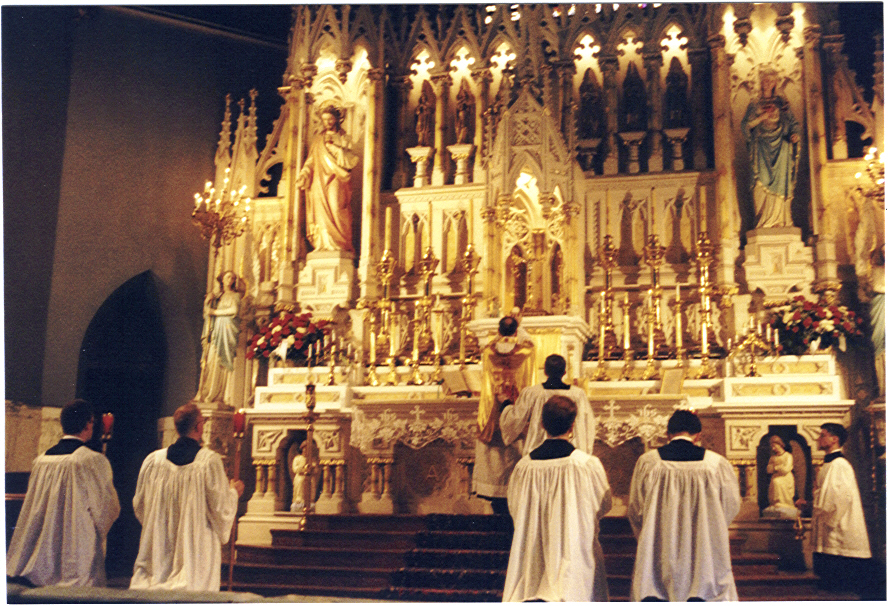
One hates to think of what will become of the magnificent high altar pictured above when Boston's Holy Trinity German Church, site of the Latin Mass in the city, is closed at the end of June. There is talk of the Tridentines being moved to a church in Chinatown, St James the Greater, which has a fine interior, but nothing like the great Bavarian wedding cake of a high altar at the German Church. What a shame it will be if it falls to the sledgehammers.
#
Rubble from the concrete altar at Cathedral of the Immaculate Conception on Cumberland Avenue waits to be removed during renovation of the Catholic church. The original, marble altar was sledgehammered during a previous restoration in the late 1960's and lies in pieces in the catacombs of the church. -- Reality X Photojournal, Portland, Maine, 1999.
More recent changes include…a new Altar of Sacrifice and Altar of Repose and a pulpit of rough textured wood and handcarved symbols. Uh, oh.
And indeed, the parish website showcases a video of Michael Joncas music performed to the side of the gutted sanctuary. Here's the URL to cut and paste: http://shsdp.org/video/shsdpchoirsm.rm
That this is presented as a highlight underscores what may be an unbridgeable gulf between those who embrace the Vosko-Haugen-Haas program and those who view it as anathema. Is there, ultimately, any ground for compromise between the camps? I'm not so sure there is, but I welcome perspectives from Todd Flowerday and the SMMMHDH.
I must point out that the reasons to be Catholic far outweigh the nonsense that one too frequently encounters in the liturgies. I would rather endure a century of hippy-dippy liturgies, guitars and pianos and "On Eagles' Wings" over a minute of beautiful High Anglitic liturgy, even if the High Anglitic liturgy were breathtaking in its grandeur and solemnity.
What musical instruments were played? An electronic keyboard/synthesizer with a very cheap-sounding piano and strings setting. Evidently the organ in the gallery is just for show.
Was the worship stiff-upper-lip, happy clappy, or what? The worship style was confusing. The keyboard was a poor foundation for the congregation singing, so basically no one sang. Everyone just stood and looked around at one another. Then suddenly they broke into a b-flat jazz-style 12/8 meter "Alleluia" at the Gospel and it was a party. Men were bouncing their babies, women were throwing their heads back, and kids were laughing hysterically. It was a very sad moment as the church laughed at, not with, the song. The cantor thought he was Enrique Inglesias, and even did a Tonight-Show-style clenched-fist-pulled-down-arm-musical-cutoff at the end of the jazz riff – I mean the Alleluia. The lowest moment of my church-going career.
In a nutshell, what was the sermon about? The sermon was actually given by the chairman of the finance committee. Apparently the congregation's giving is way down, and they need more money. We proceeded to take out the 2002 financial report from inside the service leaflet, and he itemized the spending in each department. Last year, in his words, "the church barely got by. Each of us," he stated, "must increase our contributions to the church." When he finished the congregation clapped.
How would you feel about making this church your regular (where 10 = ecstatic, 0 = terminal)? 1 – For the first time in my church-going life (19 years), I walked out of a church completely and utterly bummed out. It was evident that very few folks wanted to be there, and I cannot contemplate attending here week after week.
Now, luckily, in Greater Boston, there are plenty of Catholic churches to choose from if you don't care for the one closest, but for many people on Cape Ann, this is pretty much it, unless they speak Portuguese or feel like driving. (As the pastor is staying on at the new consolidated parish, will the Tonight Show riffs stay on, too?)
What do people do in places across the country where Vosko-Haugen-Haas is the only offering?
Going back to Erik's comment: Perhaps it's a straw choice, since Anglo-Catholic parishes like S. Clement's in Philadelphia tend to be in cities where at least one classical RC equivalent would be available, but I will say that between Mahonyism and The Advent, I'd go with the latter.
#
Thursday, March 10, 2005
Varia
Deck chairs, rearranged: How appropriate that the author of this earnest flackery on behalf of Syrian President Bashar al-Assad has previously written a book on Syrians aboard the Titanic.
Jeffersonians are principled pacifists. Hamiltonians seek a stable and orderly world made secure for the global economy. Wilsonians build international institutions that promote freedom and human rights. They also fight for a world that's safe for democracy. And finally there are Jacksonians, who are isolationist in peace time and ruthless in war time.
Harvard's Harvey Mansfield writes in the New Criterion on the "Manliness of Theodore Roosevelt." Prof. Mansfield purports to be in favor, but you get the sense he'd share the French ambassador's chagrin at actually having had to join one of TR's bracing hikes cross hill, dale and freezing stream. (Via Power Line)
* * *
"I see therein the man I hoped I was." A touching write-up appears in the Chicago Tribune on the tribute volume assembled for John Gable, executive director of the Theodore Roosevelt Association, before his recent death from cancer.
[Roosevelt biographer Edward] Renehan points to some TRA members' "Herculean efforts" to be included in the project -- noted historian Arthur M. Schlesinger Jr. was about to go into the hospital himself. So was William Harbaugh...
Renehan collected the essays, had them bound into a handsome volume and, on Jan. 18, presented the outpouring of admiration and affection to Gable at his home in Long Island, N.Y.
Gable was deeply moved by the little book. It took him several days to read it all, because of the profusion of details and the emotions they aroused.
Then he wrote a short note to Renehan, who passed it along to us:
"I see therein the man I hoped I was."
John Gable died Friday in Glen Cove, Long Island. His brother Patrick was at his side, reading aloud from the tribute book.
* * *
The NYT's Janet Maslin reviews the new TR biography, When Trumpets Call, by Patricia O'Toole:
Roosevelt's description of having cooked and eaten an elephant's heart, she says, is the most ecstatic passage in 500 pages of his "African Game Trails." So it was no wonder that when Roosevelt returned home, after state visits to Europe that included a stop in England for King Edward VII's funeral ("it will be a wonder if the poor corpse gets a passing thought," wrote one of the former president's close associates), he was armed for bear. The bear in question, President Taft, emerges as the saddest, most compelling figure in O'Toole's political group portrait.
Carl Rollyson in the NY Sun writes biographer O'Toole tapped an underutilized resource, the letters of Taft aide Captain Archie Butt, in describing the rift that formed between TR and Taft:
Not only was Butt Taft's constant companion, he had also been a confidant of TR and was uniquely placed to assess both men during the period when TR concluded that his protege had reneged on the progressive platform he had expected him to enact. Others have certainly made use of Butt's published letters, but the resourceful Ms. O'Toole checked the microfilm copies and discovered that Butt's editor had censored a good deal - especially those passages dealing with Taft's health and Butt's reflections on the tensions between TR and Taft.
Drawing not only on Butt and a multitude of other sources, Ms. O'Toole presents a riveting account of what went wrong between TR and Taft and of how TR decided to run for president under the banner of the Bull Moose party in 1912…
The scholastic Wilson and the judicious Taft made wonderful foils for the rough riding Roosevelt. TR scoffed at Woodrow Wilson as a weakling. No one would believe that Wilson was having an affair, TR told a staff member who brought the scandalous rumor to him, because Wilson had the demeanor of an apothecary clerk. In TR's view, Taft failed because he was not a proactive president. In a way, Ms. O'Toole plays TR's game, for much of her narrative emphasizes Taft's phlegmatic, timid nature, which was bolstered by an inherent conservatism. #
God Bless President Taft: Before this bit of Ruritanian filmic nostalgia at the Llamas', I'd not associated Marilyn Monroe in my mind with William Howard Taft, and I'm happy for the addition of a new toast to the prandial repertoire.
I hadn't associated the 27th president with Isaac Hayes, either, before coming across this song parody.
Who's the fat public guy who time and history passed by? (Taft!) You're damn right!
Who is the man whose Ohio dynasty stands? (Taft!) Can you dig it?
Who's the Presidential sort who made it to the Supreme Court? (Taft!) Right on!
They say this cat Taft was a bad judger? (Shut your mouth!) Well, I'm talkin' 'bout Taft! (And we can dig it!)
He's a complicated man and no one understands what's with his woman! (Mrs. Taft!)
* * *
The image (above) of President Taft campaigning is from a trove of historical prints available on cards and tee-shirts from the Boston Public Library Online Store.
Michael Lounsbery points the way to a wealth of images at the NYPL Digital Gallery, a newly-introduced database of rare prints, photos and ephemera at the New York Public Library.
Let the browser beware. The New York Public Library's collection of prints, maps, posters, photographs, illuminated manuscripts, sheet-music covers, dust jackets, menus and cigarette cards is now online...If you dive in without knowing why, you might not surface for a long, long time.
The Public Library's digital gallery is lovely, dark and deep. Quite eccentric, too.
So far, about 275,000 items are online, and you can browse by subject, by collection, by name or by keyword, at research libraries. The images first appear in thumbnail pictures, a dozen to a page. You can collect 'em, enlarge 'em, download 'em, print 'em and hang 'em on your wall at home. All are free, unless, of course, you plan to make money on them yourself. (Permission is required.)
The curators' choice this week: Turn of the Century Posters, from which the Edward Penfield number above is taken.
#
At Daniel Webster's alma mater, voting is underway in the Board of Trustees election, in which two write-in insurgents, former Reagan speechwriter Peter Robinson and the Volokh Conspiracy's Todd Zywicki, are challenging the entrenched leftist "monolith on the hill."
Is it cosmic convergence? Two Lebanons, one in the ME and one in NH, are in the news because of the unexpected movement towards the democratization of their governments. Each of these events will have long lasting repercussions among their sister institutions. The future looks inviting.
The illustration above comes from a beautiful edition of The Devil and Daniel Webster that has been posted online.
You see, for a while, he was the biggest man in the country. He never got to be President, but he was the biggest man. There were thou- sands that trusted in him right next to God Almighty, and they told stories about him and all the things that belonged to him that were like the stories of patriarchs and such. They said, when he stood up to speak, stars and stripes came right out in the sky, and once he spoke against a river and made it sink into the ground. They said, when he walked the woods with his fishing rod, Killall, the trout would jump out of the streams right into his pockets, for they knew it was no use putting up a fight against him; and, when he argued a case, he could turn on the harps of the blessed and the shaking of the earth underground. That was the kind of man he was, and his big farm up at Marshfield was suitable to him. The chickens he raised were all white meat down through the drumsticks, the cows were tended like children, and the big ram he called Goliath had horns with a curl like a morning-glory vine and could butt through an iron door. But Dan'l wasn't one of your gentle- men farmers; he knew all the ways of the land, and he'd be up by candlelight to see that the chores got done. A man with a mouth like a mastiff, a brow like a mountain and eyes like burning anthracite-that was Dan'l Webster in his prime. And the biggest case he argued never got written down in the books, for he argued it against the devil, nip and tuck and no holds barred. And this is the way I used to hear it told.
It's wonderful.
* * *
East of West Lebanon, NH: The front page of Robert Fisk's newspaper yesterday * Protests breaking out in unlikely places, via Publius Pundit
#


![[SMMMHDH]](http://www.mgilleland.com/music/smmmhdh.png)